The best GRC software for enterprise businesses depends on your primary risk domain and how much configuration your team can own. Spreadsheets, disconnected tools, and manual evidence collection break down once you manage risk across multiple business units, frameworks, and jurisdictions. This guide explains what makes GRC software enterprise grade, compares 6 platforms side by side, and shows how to choose.
What Are the Top GRC Software Solutions?
Throughout this guide we will review the following GRC software solutions:
- LogicGate
- Optro (formerly AuditBoard)
- Diligent
- MetricStream
- Vanta
- Archer (formerly RSA Archer)
What Is Enterprise GRC Software?
Enterprise GRC software centralizes risk management, regulatory compliance, vendor oversight, and internal audit into a single system of action.Teams can identify, assess, mitigate, monitor, and report on risk consistently across business units. The alternative is a patchwork of spreadsheets and point solutions that each tell part of the story.
Each letter in GRC covers a distinct job:
- Governance: The structures, processes, and policies that guide ethical conduct and strategic direction. The platform helps you define policies and maintain accountability across the organization.
- Risk management: Building risk registers, running qualitative and quantitative assessments, and tracking key risk indicators (KRIs). A unified platform shows risk across departments instead of fragmented views.
- Compliance: Operating within legal and regulatory boundaries while meeting internal and industry standards. One platform supports multiple frameworks, such as ISO 27001, GDPR, NIST, SOX, and HIPAA.
Can I Build a GRC Platform Instead of Buying One?
AI tools have made many teams consider, or even attempt, to build their own GRC platform. A narrow tracker for one team or a prototype that sharpens your requirements is often reasonable to build. The harder question is whether you can run a home-grown solution under audit, across programs, and for years after the person who built it moves on.
Gartner (June 2026) predicts that 60% of vibe-coded applications will be retired by 2028 for failing to deliver predictable business value, and that 30% of software engineering teams will see material capacity strain maintaining apps built by business users.
For enterprise programs, ask yourself these four questions to understand if your requirements align to building or buying a platform:
- Can you prove who did what, with role-based access, change history and approvals an auditor will accept?
- What does it cost over three years, counting rework and engineering time?
- Who maintains it when a framework changes?
- Can it report across programs in a form that is actionable to all of your stakeholders?
A GRC platform ships with those four critical capabilities built-in and maintained over time. The general recommendation is to build when the need is narrow and low-stakes. Buy when auditors, regulators or many teams will rely on the result.
What Makes a GRC Platform Enterprise Grade?
An enterprise-grade platform differs from a departmental tool in four ways. Not every GRC product checks all four boxes.
- Scalability: Support for complex organizational structures, large user bases, and multi-entity deployments without performance loss.
- Security: A strong security posture, including certifications such as SOC 2 Type II, is table stakes.
- Configurability: Teams adapt workflows without writing code, which determines how fast you can respond to new regulations.
- Integration depth: Connections across cloud infrastructure, HR systems, security tools, and ERP enable automation instead of manual data entry.
The best platform also depends on your focus and existing stack. A financial services firm with mature SOX programs has different needs than a healthcare organization prioritizing HIPAA and third-party risk.
Which Enterprise GRC Platforms Compare Best at a Glance?
| Platform | Best For | Standout Strength |
| LogicGate | No-code, agentic GRC for truly holistic insights | Enterprise-level risk aggregation, agentic applications with auditable AI, GRC lifecycle management |
| Optro (formerly AuditBoard) | Audit-led programs expanding into broader GRC | Audit management and collaboration |
| Vanta | Continuous, telemetry-driven compliance monitoring | Continuous controls monitoring and deep integrations |
| Diligent | Board-level governance and reporting | Board, audit, and ESG workflows |
| Archer (formerly RSA Archer) | Mature programs that need deep customization | Configurable risk taxonomy mapping |
| MetricStream | Breadth of coverage across GRC domains | Modules for ERM, SOX, internal audit, and vendor risk |
How Did We Evaluate the Best GRC Software for Enterprise Businesses?
We assessed each platform against seven criteria that matter most to enterprise buyers. The right-hand column gives you a question to put to every vendor on your shortlist.
| Criterion | What We Assessed | Question to Ask Vendors |
| Framework coverage | Breadth of support for major regulatory and security frameworks | Which frameworks are prebuilt, and are controls crosswalked between them? |
| Integration depth | How well the platform connects with enterprise systems | Which integrations are native, and which require custom API work? |
| Data aggregation | How effectively the platform centralizes and connects risk data | Can findings from one domain roll up into the enterprise risk register? |
| AI and automation | Maturity of AI capabilities and workflow automation | What runs without human approval? What runs with human oversight? Can I see the reasoning for each result? |
| No-code workflow builder | How easily teams adapt workflows without developer support | Can my team change a process without professional services? |
| Analyst and peer recognition | Gartner, Forrester, IDC, G2, and verified peer feedback | Which analyst reports name you a Leader, and in which year? |
| Total cost and time-to-value | Implementation timelines and cost of ownership | What is the three-year cost, including services and configuration? |
Every claim draws on public analyst reports or vendor-published information, so we recommend you validate details during your own evaluation.
Which GRC Platforms Do Analysts Name as Leaders?
Analyst reports are the most independent signal available to enterprise buyers. The table below lists Leaders confirmed in the announcements reviewed for this guide, and other vendors may also be named in each report.
| Report | Published | Leaders Confirmed in This Review |
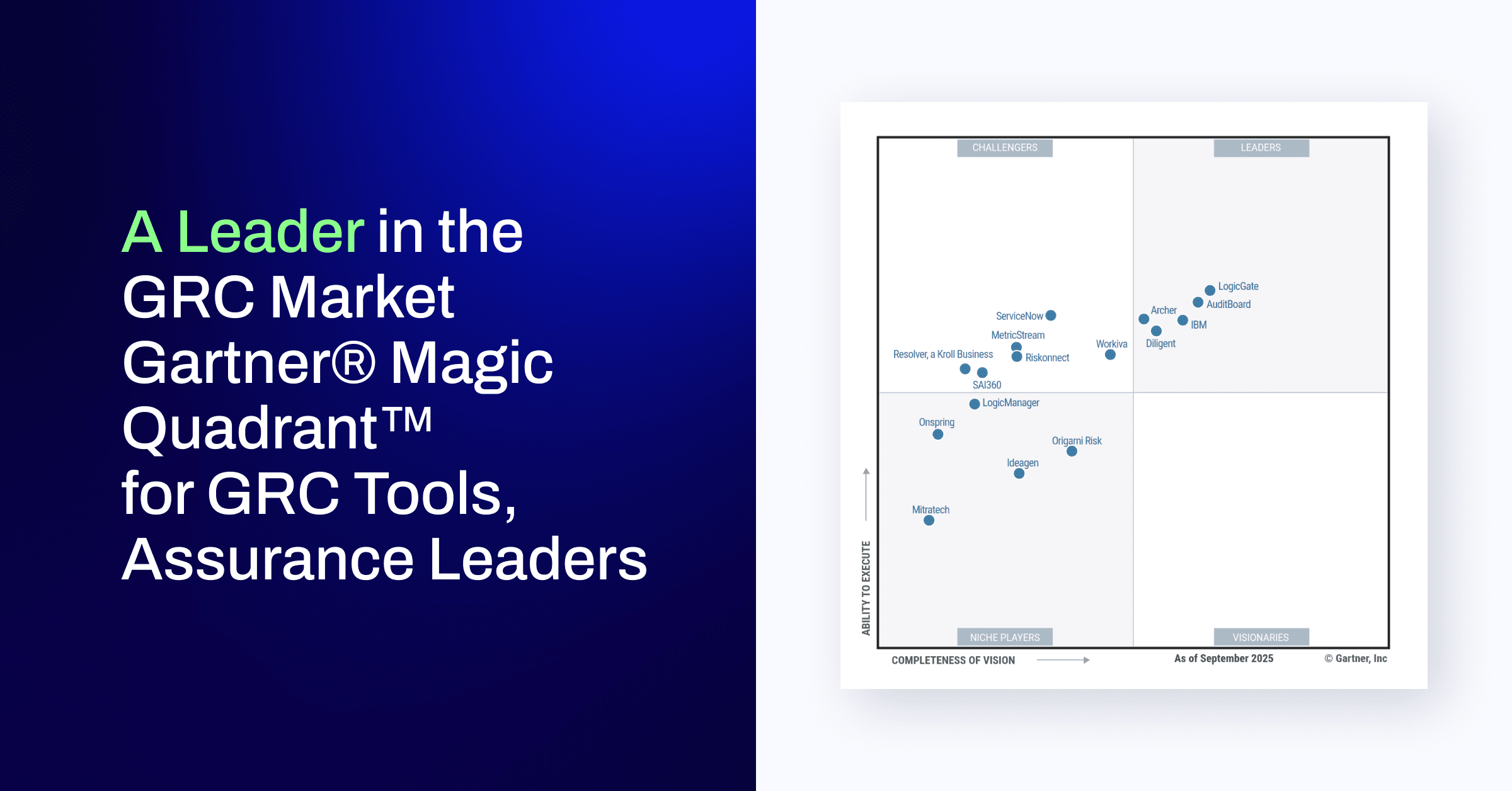
| Gartner Magic Quadrant for GRC Tools, Assurance Leaders | October 27, 2025 | LogicGate, AuditBoard (now Optro), Archer, Diligent |
| The Forrester Wave: Governance, Risk, and Compliance Platforms, Q2 2026 | May 2026 | LogicGate, Optro, Vanta, Diligent |
| IDC MarketScape: Worldwide Third-Party Risk Management Software 2026 | September 2026 | LogicGate, Optro, Vanta, Archer, Diligent |
LogicGate has also held G2 Leader status for 29 consecutive quarters, through the Fall 2026 badge cycle.
What Are the Best GRC Software Platforms for Enterprise Businesses?
LogicGate is listed first. The remaining platforms follow by analyst recognition, then by specialty, and each entry names the buyer it suits best.
1. Why Choose LogicGate for Enterprise GRC?
LogicGate is the Leading AI GRC Platform for the Enterprise, built on a no-code, flexible graph database. It offers more than 30 purpose-built applications across enterprise risk management, cyber risk, third-party risk management, controls compliance, and internal audit. Data connects across those domains, so a single finding can roll up into the enterprise risk register.
Gartner named LogicGate a Leader in its 2025 Magic Quadrant for GRC Tools. Forrester named it one of four Leaders in the Q2 2026 GRC Wave. LogicGate earned the highest possible score on eight criteria, including integrations, technology risk management, usability, and workflow.
What sets LogicGate apart for enterprise buyers:
- No-code workflow builder: A drag-and-drop interface allows users to easily create, link, and customize workflows without coding expertise. Config Newton, an AI builder agent that takes Risk Cloud from no-code to no-click, can now help advise, build, and champion your GRC programs.
- Connected data model: The no-code graph database links risks, controls, and assets across programs, teams, and instances. Roll-up and drill-down reports keep dynamic data connected while the Insights Agent acts as an on-demand data analyst across your entire environment.
- Agentic GRC with human review: GRC Agents are generally available for critical programs like third-party risk management, cyber risk management, and enterprise risk management.Every agent action is permissioned, logged, and routed to a designated reviewer.
- Automated Compliance: Automated Control Testing checks submitted evidence against the parent control. It returns a result with the evaluation rationale,alerts on critical gaps, and recommends corrective actions.
- Risk quantification: Risk quantification supports Monte Carlo simulation and the Open FAIR model to translate risks into financial terms, enabling strategic prioritization and ROI‑focused decision‑making.
- Value Realization: The Value Realization Tool demonstrates and communicates the value of GRC programs through tangible benefits like resource efficiencies, revenue enablement, and risk reduction. It aggregates your existing program data and performs cross-functional calculations to build real-time value dashboards for relevant use cases.
Best for: Enterprises that want one holistic platform across GRC programs for maximum visibility and the ability to quickly adapt without costly configuration.
2. When Does Optro (Formerly AuditBoard) Fit Best?
AuditBoard rebranded as Optro in March 2026 around an agentic GRC narrative. It was named a Leader in the 2025 Gartner Magic Quadrant and in the Q2 2026 Forrester Wave. Optro reports the highest possible Forrester scores on audit management, risk quantification, and user experience, among other criteria.
Best for: Teams where internal audit and SOX programs are the entry point to broader GRC.
3. Is Vanta Right for Continuous Compliance Monitoring?
Vanta grew out of compliance automation and was named a Leader in its first-ever Forrester GRC Wave in Q2 2026. Its Trust Graph connects to more than 400 integrations and runs more than 1,400 continuous tests, according to Vanta. In June 2026 it added an agent that unifies internal and third-party risk.
Best for: Teams that prioritize always-on, telemetry-driven control monitoring.
4. Does Diligent Suit Board-Level Governance?
Diligent focuses on board governance, audit management, and ESG. It was named a Leader in the Q2 2026 Forrester Wave. Diligent reports Leader recognition from five analyst firms.
Best for: Enterprises that prioritize board-level risk reporting and governance workflows.
5. What Is Archer Best At?
Archer, formerly RSA Archer, is an established platform with deep configuration options and large-scale deployments. It offers complex risk taxonomy mapping suited to highly regulated industries such as financial services and healthcare. In September 2026 it launched Evolv AI Compliance, a separately priced product for enforcing AI policy.
Best for: Mature GRC programs that require extensive customization and have the in-house resources to support the platform.
6. Where Does MetricStream Fit?
MetricStream is built for enterprise-wide visibility, with scalable modules for enterprise risk, SOX compliance, internal audit, and vendor risk.
Best for: Large organizations that prioritize breadth of coverage across GRC domains.
What Features Should Enterprise GRC Software Include?
Assess every platform against the same core capabilities. Here is what matters most.
Why Does No-Code Configuration Matter?
No-code platforms let GRC teams build and modify workflows without IT dependency. You can adapt to a new framework or process change in days instead of waiting months for developer resources. This also lowers total cost of ownership for self-sufficient risk teams.
How Does Automated Evidence Collection and Control Testing Work?
Automated evidence collection pulls audit artifacts directly from connected systems. Automated control testing then checks that evidence against the control and returns a result with its rationale. A human reviewer validates the outcome, which keeps you audit-ready year-round instead of scrambling before each assessment.
What Do AI Agents Actually Automate in GRC?
GRC agents handle repetitive tasks, such as autofilling assessments and drafting risk narratives. Unlike generic AI tools, GRC-specific agents produce auditable, explainable outputs for regulated environments. People stay in the loop for final decisions.
Why Use Quantitative Risk Modeling?
Quantitative modeling translates risk into financial terms your board understands. Techniques such as Monte Carlo simulation and the Open FAIR model move you beyond heat maps. You can answer questions such as “What is our probable loss exposure from this vendor relationship?”
What Is a Connected Risk and Compliance Data Model?
A connected data model links assets, threats, controls, risks, and more across domains as well as unique team structures and instance management. Fragmented point solutions and inflexible data taxonomies create blind spots. A truly unified and dynamic platform shows how a vulnerability in one area affects controls and obligations elsewhere.
What Reporting Do Enterprise Teams Need?
Enterprise platforms provide real-time dashboards for executives and detailed drill-downs for practitioners. Role-based views let your CISO see cyber risk trends while your audit committee sees control effectiveness. Strong reporting and analytics also support board-level risk discussions.
Which Frameworks and Integrations Should Be Built In?
Prebuilt frameworks such as NIST, ISO 27001, SOC 2, GDPR, HIPAA, and DORA accelerate program setup. Crosswalks let you map one control to multiple requirements without duplicating effort. Native integrations with cloud, HR, security, and ERP systems support automated evidence collection.
What Are the Benefits of Enterprise GRC Software?
Features matter, but outcomes matter more. Enterprise GRC software should deliver these results in practice:
- Enterprise-wide risk visibility: First-line operational risk and second-line compliance teams work from one view instead of stitched-together reports.
- Faster audit readiness: Harmonized controls and automated testing reduce audit preparation time and support continuous compliance.
- Less administrative work: Workflow automation and support from AI agents frees specialists to focus on strategic risk decisions.
- Cross-functional collaboration: Risk, compliance, audit, security, and privacy teams share workflows instead of email chains.
- Scalable program maturity: The platform grows from initial deployment to organization-wide risk management without a migration.
How Do You Choose the Right Enterprise GRC Software?
Selecting a platform takes a structured evaluation. Follow these six steps.
- Map your risk and compliance domains. Inventory which domains you need, such as ERM, cyber risk, third-party risk, compliance, and audit. List the frameworks you will support.
- Define required integrations. List your cloud infrastructure, HR systems, security tools, and ERP systems. Prioritize native connections that enable automated evidence collection.
- Test no-code configurability. Ask each vendor to configure a new form, framework, or process change live during the evaluation.
- Assess AI and automation. Confirm AI outputs are auditable and explainable. Ask what runs without human approval.
- Review analyst and peer recognition. Check the Gartner Magic Quadrant, Forrester Wave, IDC MarketScape, and G2 reviews. Gartner Peer Insights adds verified user feedback.
- Model time to value and total cost. Compare implementation timelines and three-year cost of ownership. Platforms with prebuilt applications and no-code configuration typically reach value faster than legacy systems.
How Is AI Reshaping Enterprise GRC?
AI is shifting GRC from reactive to proactive. Instead of waiting for audits to surface gaps, AI GRC platforms review evidence continuously and automate high-volume tasks. Human reviewers keep ownership of every decision.
Four capabilities define the shift:
- Autofill and drafting: AI prepopulates assessments, findings, and recommended next steps, which reduces manual data entry.
- Control testing automation: AI tests submitted evidence against controls and explains its rationale for human validation.
- Risk and compliance content generation: AI drafts structured content faster than manual writing.
- Natural language configuration: Plain-language inputs simplify workflow setup, reporting, and shorten implementation timelines.
Governance matters as much as capability. The EU AI Act and the NIST AI Risk Management Framework now shape how enterprises oversee their own AI use. Platforms with built-in AI governance help teams apply those rules.
How Can You Modernize Your Enterprise GRC Program With LogicGate?
LogicGate gives enterprises a connected, no-code AI GRC platform to replace siloed processes with unified risk management. Teams automate workflows, gain enterprise-wide visibility, and stay audit-ready with human review built in.
Request a demo to see how LogicGate can accelerate your GRC program.
Frequently Asked Questions About Enterprise GRC Software
What Is the Best GRC Software for Enterprise Businesses?
The best platform depends on your primary risk domain and how much configuration your team can own. LogicGate fits enterprises that want a no-code, connected platform across ERM, third-party risk, cyber risk, and compliance. Optro, Vanta, Diligent, and IBM OpenPages suit audit-led, continuous-compliance, board-governance, and analytics-heavy programs.
Does Microsoft Have a GRC Solution?
Microsoft offers Microsoft Purview Compliance Manager for compliance management and Microsoft Defender for Cloud for security posture. It does not provide a unified, full-suite GRC platform comparable to dedicated enterprise GRC vendors.
How Long Does Enterprise GRC Software Implementation Take?
Timelines vary by platform complexity and organizational scope. Modern no-code platforms with prebuilt applications can often deploy in weeks or a few months, while legacy systems that require extensive customization typically take longer.
LogicGate cites deployment in 30-90 days depending on complexity.
What Is the Difference Between GRC and IRM?
GRC (governance, risk, and compliance) is the broader discipline and technology category. IRM (integrated risk management) is a term Gartner uses to emphasize connected, enterprise-wide risk visibility. Many platforms serve both definitions.
How Much Does Enterprise GRC Software Cost?
Cost depends on the modules you need, your user model, and implementation services. Ask every vendor for a three-year total that includes configuration and professional services. Platforms with no-code configuration and prebuilt applications typically reduce total cost of ownership.
Is GRC Software Only for Regulated Industries?
No. Highly regulated industries such as financial services and healthcare are common adopters. Any enterprise that manages operational risk, vendor relationships, or internal policies benefits from centralized GRC software.