The best software for AI governance connects every AI use case to the risks, controls, policies, and vendors it touches. It automates intake, triage, and first-pass assessment. It leaves approval decisions with accountable humans and keeps a complete audit trail.
Choosing the best software for AI governance requires matching the tool to your team’s specific risk, compliance, and oversight needs.
Why Does AI Governance Software Matter Now?
AI adoption is outpacing oversight. IBM and the Ponemon Institute surveyed breached organizations for the Cost of a Data Breach Report 2025. They found that 13% reported breaches of AI models or applications.
Of those breached organizations, 97% lacked proper AI access controls. Another 63% had no AI governance policy or were still developing one. High levels of shadow AI added $670,000 to the average breach cost.
Regulators are also moving. The EU AI Act (Regulation (EU) 2024/1689) is the foundational, risk-based AI law. The Digital Omnibus on AI (Regulation (EU) 2026/1744) amends it to adjust timelines and streamline compliance.
The Omnibus was published in the Official Journal on 24 July 2026 and entered into force on 27 July 2026. It moves Annex III high-risk obligations to 2 December 2027 and Annex I obligations to 2 August 2028. Most Article 50 transparency duties still apply from 2 August 2026.
A later deadline is not a lighter workload. Teams still need an inventory, risk classification, and evidence trail before any date arrives.
What Does AI Governance Software Actually Do?
At minimum, it gives governance teams one place to register AI use cases and models. It routes each submission to the right assessment path and records who approved what.
Strong platforms also map each use case to a framework. The NIST AI Risk Management Framework, released on January 26, 2023, organizes the work into Govern, Map, Measure, and Manage.
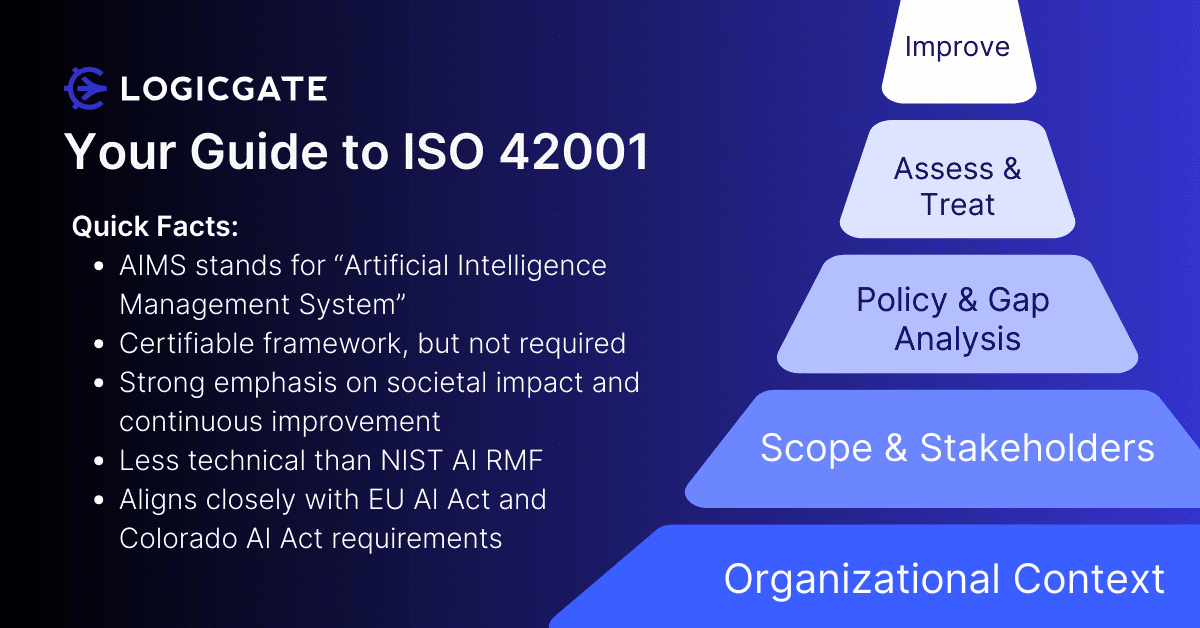
ISO/IEC 42001:2023 adds requirements for an AI management system, published in December 2023. Software should turn both into workflows, not PDFs, so assessments and mitigations become auditable records.
What Are the Top AI Governance Software Platforms in 2026?
LogicGate is listed first because this is LogicGate’s own guide. The order of the other vendors is not a ranking.
- LogicGate AI Governance: an enterprise GRC approach that connects AI governance to critical functions like third-party risk management, regulatory compliance, and business continuity planning, with AI Governance Agents that augment team performance.
- IBM watsonx.governance: governance for AI across environments, with automated policy enforcement and evidence capture.
- ServiceNow AI Control Tower: discovery and control of AI agents, models, and MCP servers on the ServiceNow AI Platform.
- OneTrust AI Governance: a privacy-led AI inventory with risk tiering and runtime guardrails.
- Credo AI: an AI registry with policy packs mapped to specific regulations.
- Holistic AI: AI testing, red teaming, and enforcement for technical teams.
- Optro: an AI-powered GRC platform, formerly AuditBoard, that extends audit and risk programs to AI governance with structured intake, a centralized AI inventory, and risk-assessment workflows.
How Do the Top AI Governance Platforms Compare at a Glance?
This table summarizes each vendor’s positioning, based on its public product pages.
| Platform | Best For | Standout Strength |
| LogicGate AI Governance | GRC teams that want AI governance dynamically linked to risk, vendors, policies, and more | Fully explainable and auditable AI Governance Agents and a graph database of interconnected data across use cases, vendors, and risks |
| IBM watsonx.governance | Large enterprises governing many models and agents | Automated policy enforcement, obligation mapping, and a governance graph |
| ServiceNow AI Control Tower | Organizations already on the ServiceNow AI Platform | Discovery of AI agents, models, and MCP servers, plus an AI identity and access layer |
| OneTrust AI Governance | Privacy-led programs that already use OneTrust | AI inventory, risk tiering from regulatory templates, and runtime guardrails |
| Credo AI | Teams that want regulation-specific policy packs | AI Registry with shadow AI detection and prebuilt policy packs |
| Holistic AI | Technical teams focused on testing and red teaming | 40+ tests for bias, hallucination, privacy, and robustness |
| Optro AI Governance | Audit-led teams that want AI governance alongside internal audit and compliance | Structured AI intake, a centralized AI inventory, and agentic governance workflows for autonomous systems |
What Criteria Should You Use to Compare AI Governance Software?
Use the same checklist for every vendor. The differences show up fastest when each tool handles a real submission.
| Criterion | What We Assessed | Question to Ask Vendors |
| Intake and discovery | Whether new AI use cases and shadow AI surface early | How does a new use case or unsanctioned tool enter the inventory? |
| Assessment and frameworks | Scoring against your risk framework, NIST AI RMF, or ISO/IEC 42001 | Can you show linked mitigations, not a static questionnaire? |
| Connected data | Links between use cases, vendors, policies, and risks | Can I trace a model to its supplier and the risks it creates? |
| Human approval | Named approvers for consequential decisions | Can I see the approval record for one use case? |
| Audit trail | Evidence of who decided what, when, and why | What would an auditor receive? |
| Configurability | Whether risk teams can change workflows without IT | Who builds and edits the workflows? |
How Do Analysts Rate AI Governance Platforms?
Analyst coverage of AI governance is new, and the categories differ. The table lists only placements confirmed in this review.
| Report | Published | Leaders Confirmed in This Review |
| Forrester Wave: Governance, Risk, and Compliance Platforms | Q2 2026 | LogicGate |
| Gartner Magic Quadrant for AI Governance Platforms | 2026 | IBM, ServiceNow, Truyo |
| IDC MarketScape: AI Governance Platforms 2025-2026 | 2025-2026 | IBM |
| Forrester Wave: AI Governance Solutions | Q3 2025 | IBM |
LogicGate is not named in Gartner’s 2026 Magic Quadrant for AI Governance Platforms. Its analyst recognition sits in the broader GRC category. Gartner places OneTrust and Credo AI as Visionaries and Holistic AI as a Challenger.
Which Is the Best Software for AI Governance for Your Team?
1. What Is LogicGate AI Governance Best At?
Best for: GRC and risk teams that want AI governance connected to third-party risk, enterprise risk, regulatory compliance, policy management, and more.
LogicGate runs AI Governance on Risk Cloud, its agentic GRC platform. GRC Agents for AI Governance became generally available in the Summer 2026 release. They sit alongside agents for critical programs like, Third-Party Risk Management, Cyber Risk Management, Enterprise Risk Management, Issues Management, and Business Continuity Management.
- AI Governance Intake Agent: Triages newly submitted use cases and routes them to the right assessment path.
- AI Governance Assessment Agent: Evaluates a use case against the customer’s risk framework and creates linked mitigations.
- Human-In-The-Loop: Review and approve every AI output with complete explainability and audit trail.
- Graph Database: Links AI use cases to vendors, risks, policies, and assessments via Risk Cloud’s no-code graph database.
- Frameworks: Supports EU AI Act, NIST AI RMF and ISO/IEC 42001 to help teams prepare for a variety of AI regulations.
LogicGate reports a 75% reduction in AI use case assessment time, based on its customer case studies. Treat that as a vendor-reported figure and ask any provider for comparable evidence.
2. What Is IBM watsonx.governance Best At?
Best for: large enterprises that need to govern many models and agents across hybrid environments.
IBM positions watsonx.governance as a way to govern any AI, anywhere. It builds a living map of the AI ecosystem and automates policy enforcement, obligation mapping, and evidence capture.
- Shadow AI detection: surfaces AI that teams run outside approved channels.
- Governance graph: connects AI assets to the policies and obligations that apply to them.
- Regulatory content: includes EU AI Act, NIST AI RMF, and ISO 42001 content.
IBM also offers OpenPages for broader GRC. It reports Leader placements in Gartner, IDC, and Forrester evaluations of AI governance platforms.
3. What Is ServiceNow AI Control Tower Best At?
Best for: organizations already standardized on the ServiceNow AI Platform.
ServiceNow AI Control Tower discovers AI agents, models, and MCP servers, including shadow AI. It runs on the ServiceNow AI Platform and CMDB. ServiceNow aims it at chief AI officers, CIOs, CTOs, and risk and security leaders.
- AI identity and access: issues each agent an “AI Passport” and controls what it can reach.
- Kill switch: lets teams shut down an agent that behaves outside policy.
- Compliance gates: include content packs for the EU AI Act and NIST AI RMF.
4. What Is OneTrust AI Governance Best At?
Best for: privacy and compliance teams that already use OneTrust.
OneTrust keeps an inventory of AI systems, models, agents, datasets, and vendors. It tiers risk using EU AI Act, NIST AI RMF, and ISO 42001 templates.
- Runtime observation: watches AI activity on Amazon Bedrock and Microsoft Foundry.
- Policy enforcement: pairs an AI Policy Manager with Guardrail Enforcement and an AI Guard Python SDK.
- Agent and MCP governance: extends oversight to agents and the tools they call.
Gartner named OneTrust a Visionary in its 2026 Magic Quadrant for AI Governance Platforms.
5. What Is Credo AI Best At?
Best for: teams that want policy packs mapped to specific regulations.
Credo AI combines an AI Registry with shadow AI detection, Risk Intelligence, and a Policy Engine. Its GAIA assistant helps teams work through assessments.
- Policy packs: cover the EU AI Act, NIST AI RMF, ISO 42001, OMB M-25, Colorado ADMT, and NAIC AI rules.
- Agent Governor: governs AI agents and is currently a research preview.
Credo AI reports a Leader placement in a Forrester Wave. Gartner named it a Visionary in 2026.
6. What Is Holistic AI Best At?
Best for: technical teams that prioritize testing and red teaming.
Holistic AI describes an enterprise AI governance platform with Identify, Protect, and Enforce layers. It includes inventory and discovery for AI systems.
- Testing: runs 40+ tests for bias, hallucination, privacy, and robustness.
- Red teaming: probes models for weaknesses before and after release.
- Guardian Agents: enforce policy on AI behavior at runtime.
Gartner named Holistic AI a Challenger in its 2026 Magic Quadrant for AI Governance Platforms.
7. What Is Optro Best At?
Best for: audit-led teams that want AI governance alongside internal audit, SOX, and compliance work.
Optro, formerly AuditBoard, describes its platform as an AI-powered GRC system of action. It unifies audit, risk, infosec, compliance, and AI governance, and its AI governance capabilities draw on the FairNow acquisition.
- Intake and inventory: structured intake for AI initiatives and a centralized AI use-case and model inventory.
- Assessment and approval: risk-assessment and approval workflows with documentation mapped to frameworks such as NIST AI RMF.
- Agentic governance: frameworks and workflows to discover, register, and assess autonomous systems.
Vendor details come from public vendor pages and analyst announcements as of November 2026. Confirm current capabilities with each vendor before you decide.
How Do You Evaluate AI Governance Vendors Fairly?
Start with the outcome, not the feature list: an AI risk management system that keeps running after the first assessment. ISO/IEC 42001 frames this as a cycle of planning, operating, monitoring, and improving, and the EU AI Act expects high-risk AI risk management to be continuous and iterative. A tool that handles intake well but can’t support that cycle will leave gaps by your first audit.
No single vendor covers every part of AI governance. Discovery of shadow AI, technical testing and red teaming, runtime guardrails, and governance workflow are different jobs, and the strongest products usually specialize. Most mature programs end up with two layers:
- A system of record and action. This is where use cases, risks, controls, policies, vendors, approvals, and evidence live, and where work gets assigned, reviewed, and closed out.
- Discovery and technical inputs. These tools find unsanctioned AI, test models, and monitor behavior, then feed what they find into the system of record.
Evaluate each vendor against the layer it would play:
- Which layer is this? Be honest about whether a tool is built to record and act, or to detect and test.
- Does it support the full cycle? Look for reassessment triggers, issue tracking, and remediation, not only initial intake and scoring.
- Can it connect? Ask how discovery findings and test results enter the platform, and whether a use case can be traced to its vendor, risks, policies, and controls without rebuilding data.
- Who owns each decision? Ask to see the approval record and audit trail for one use case, including who decided, when, and why.
- Can your team run it? Check whether risk and compliance teams can change workflows without IT.
LogicGate is built to be the system of record and action. AI use case management connects use cases to vendors, risks, and policies, and AI Governance Agents handle triage and first-pass assessment with human approval at each decision. Pair it with a discovery or testing tool if shadow AI detection or model-level testing is your biggest gap.
What Are the Most Common Questions About AI Governance Software?
What Is AI Governance Software?
AI governance software is a platform that inventories AI use cases, assesses their risks, and enforces policies and approvals. It records the evidence needed to show oversight to auditors and regulators.
Do You Need a Separate AI Governance Tool With an Existing GRC Platform?
Not always. If your GRC platform links AI use cases to risks, vendors, and policies, you may extend it instead. A standalone tool makes sense when you need discovery and deep model testing that GRC platforms do not provide.
Which Frameworks Should AI Governance Software Support?
At a minimum, look for NIST AI RMF and ISO/IEC 42001. Also confirm how the vendor tracks EU AI Act obligations and U.S. state laws such as the Colorado AI Act. For a deeper look at framework requirements, see What Is an AI Governance Framework?.
Do AI Agents Replace Governance Reviewers?
No. Agents handle triage and first-pass evaluation, while people own the risk decisions. A credible product shows the approval step and the audit trail for every outcome.
Which AI Governance Platforms Do Analysts Recognize?
Gartner’s 2026 Magic Quadrant for AI Governance Platforms names IBM, ServiceNow, and Truyo as Leaders. LogicGate’s recognition sits in the broader GRC category, including a Leader placement in the Forrester Wave for GRC Platforms, Q2 2026.