Managing governance, risk, and compliance across multiple countries isn’t just harder than single-jurisdiction programs: it’s a fundamentally different challenge. You’re navigating overlapping regulations, decentralized teams, and stakeholders who expect both regional detail and enterprise-wide visibility from the same platform.
The GRC software features that work for a domestic operation often fall short when you’re operating across borders. This blog covers the ten capabilities that matter most for global companies, how to evaluate vendors, and what to expect when rolling out a platform across regions.
What Is GRC Software for Global Companies?
GRC software (governance, risk, and compliance software) is a centralized platform that helps organizations manage business policies, assess threats, operational resilience, and automate regulatory requirements. Rather than juggling scattered spreadsheets and disconnected tools, you get a single system that tracks compliance, monitors risks, and keeps audit evidence in one place.
For global companies, though, the regulatory requirements go further. You’re dealing with GDPR in Europe, SOX in the U.S., LGPD in Brazil, and potentially dozens of other frameworks depending on where your teams and data live. A GRC platform built for multinational operations maps controls to multiple frameworks at once, tracks compliance across jurisdictions, and gives you real-time dashboards that show risk posture across the entire enterprise.
The distinction matters because a platform designed for one regulatory environment often lacks the framework libraries, localization features, and flexible data architecture that global programs require.
Why Do Global Companies Need Different GRC Software Than Single-Jurisdiction Firms?
Operating across borders introduces complexity that domestic-only firms simply don’t face. Regulations overlap, sometimes conflict, and evolve at different speeds depending on where your teams and data reside.
Here’s what makes global GRC distinct:
- Regulatory overlap: Multiple frameworks apply simultaneously across subsidiaries. Your European operations face GDPR while your California team deals with CCPA, and industry-specific rules layer on top of both.
- Control instance proliferation: A single global policy often dictates hundreds of localized risk and control instances. Managing the parent-child relationships between a baseline corporate mandate and its specific regional executions creates a web of many-to-many relationships that breaks basic tools.
- Data residency requirements: Different countries mandate where data can be stored, processed, and transferred. This affects how you configure workflows, where you collect evidence, and how you structure reporting.
- Decentralized operations: Risk and compliance teams work across time zones, languages, and reporting structures. Without centralized visibility, you end up with fragmented risk data and inconsistent processes.
- Stakeholder reporting: Boards and regulators in each region expect localized detail, while enterprise leadership wants a consolidated view. You’re serving multiple audiences with different expectations.
A platform that works well for a single-country operation often struggles with these realities. The features below address them directly.
10 Essential GRC Software Features for Global Companies
1. Multi-Framework and Multi-Jurisdiction Regulatory Content
Regulatory content libraries are pre-built collections of frameworks, including ISO 27001, NIST CSF, GDPR, SOC 2, and others, already mapped to controls and requirements within the platform. For global companies, this eliminates the tedious work of manually crosswalking frameworks across jurisdictions.
When you’re operating in multiple regions, you might have a single control that satisfies requirements in three different frameworks. A good platform recognizes that relationship automatically, so you’re not duplicating effort or losing track of coverage gaps. LogicGate Risk Cloud®, for example, includes a frameworks library aligned to 30 leading standards with the ability to add custom frameworks as regulations evolve. LogicGate also delivers automated control monitoring via automated evidence and first-pass control evaluations.
2. No-Code Workflow Automation
No-code automation refers to drag-and-drop workflow builders that let business users configure processes without waiting on developers. This matters for global teams because regional requirements often differ, and IT bottlenecks slow everything down.
When your compliance lead in Germany can adapt an assessment workflow to reflect local requirements (without submitting a ticket and waiting weeks), your program moves faster. You’re not locked into a rigid process that doesn’t reflect how different regions actually operate.
3. Centralized Data Model With a Flexible Graph Database
A graph database is a data structure that maps relationships between risks, controls, policies, vendors, and assets. Unlike traditional relational databases, it shows you how a single control supports multiple frameworks, or how one vendor relationship connects to several risk categories.
For global operations, this connected data model provides enterprise-wide visibility without forcing every region into identical processes. You can trace a risk from a subsidiary in Singapore to its impact on your consolidated risk register, and see which controls mitigate it across the organization. LogicGate’s flexible no-code graph database is designed for exactly this kind of connected analysis.
4. AI Skills and Agents for GRC
Foundational AI skills can include automated evidence reviews, policy drafting assistance, reporting insights, and intelligent form completion. In high-volume global programs, these features accelerate tasks that otherwise consume significant time.
The key distinction is intentional AI with human oversight, not black-box automation that introduces new risks. Humans are in control of all critical decisions.
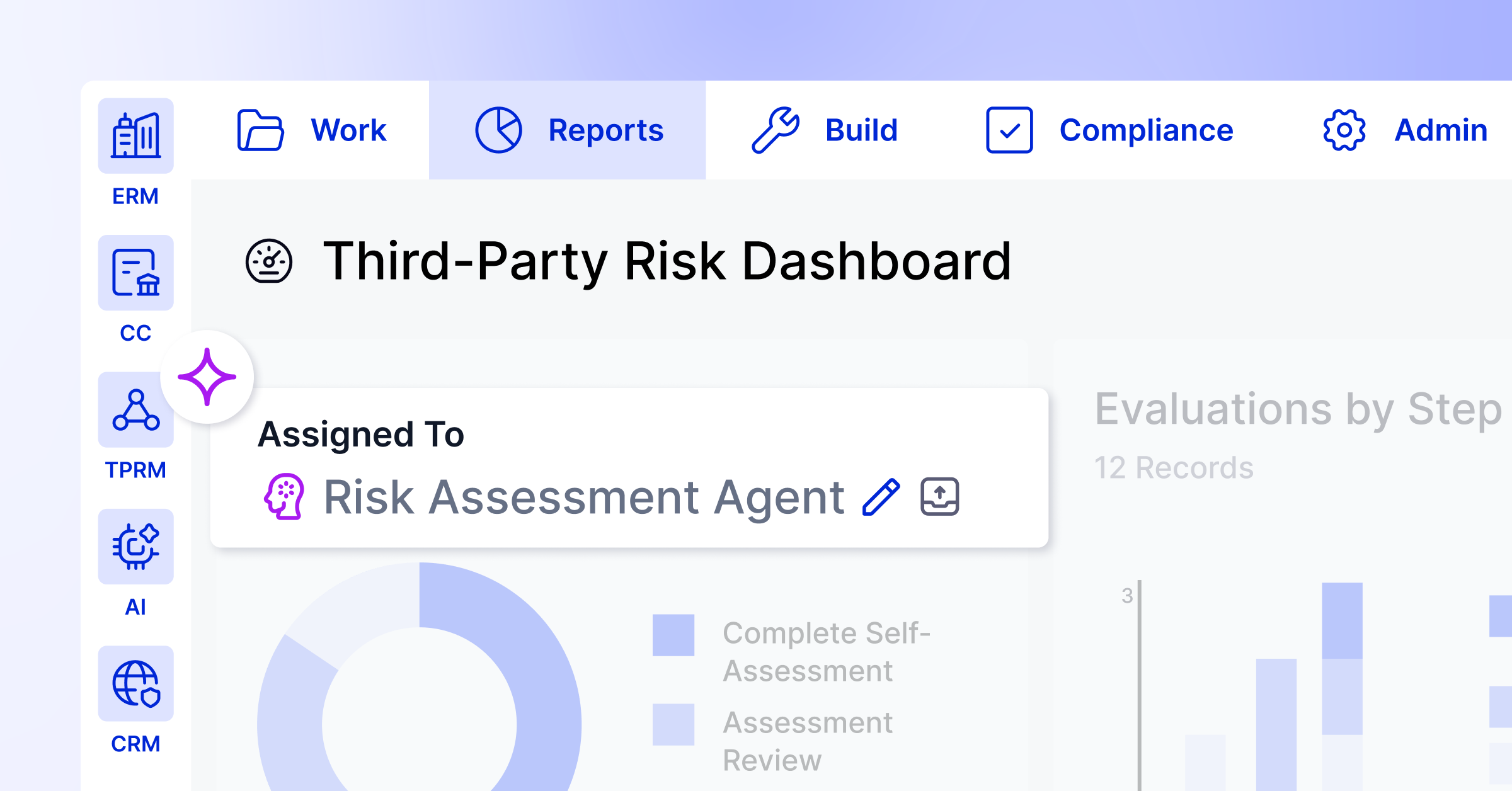
For more complex GRC use cases, AI agents represent a powerful evolution in modern GRC technology, moving beyond automated assistance to execute complex, multi-step workflows autonomously. Designed to reason, adapt, and execute end-to-end tasks within established policy guardrails, AI agents transform how global teams navigate complex risk environments. By handling routine data collection, initial risk scoring, and continuous workflow orchestration, these agents shift practitioner focus away from time-consuming administration and toward high-impact, strategic priorities.
LogicGate GRC Agents bring targeted AI capabilities to several core risk and compliance areas, including:
- Third-Party Risk Management (TPRM): Automating vendor assessments, parsing security documentation, and flagging potential supply chain vulnerabilities in real time.
- Enterprise Risk Management (ERM): Automating high-volume risk intake, assessments, and reporting to continuously aggregate risk indicators and maintain an accurate, enterprise-wide risk profile.
- AI Governance: Automatically evaluate and flag new use cases against a risk framework to ensure compliance with relevant policies and regulatory compliance.
- Business Continuity Management (BCM): Assisting with impact analyses and maintaining operational resiliency plans as business conditions evolve.
5. Automated Evidence Collection and Control Testing
Automated evidence collection means integrations that pull compliance artifacts (security configurations, access logs, policy acknowledgments) directly from source systems. Combined with Automated Control Testing, the system can track whether controls remain effective over time, not just at a point-in-time audit.
For distributed global teams, this keeps programs audit-ready without requiring manual evidence gathering across every region. When an auditor asks for proof of control effectiveness, you have current, documented evidence rather than scrambling to collect screenshots from five different time zones.
6. Financial Risk Quantification
Risk quantification translates risks into monetary terms using models like Open FAIR or Monte Carlo simulations. Instead of describing a risk as “high” or “medium,” you express it as a potential financial loss range with confidence intervals.
Boards and executives respond to financial language. When you can show that a third-party risk represents a potential $2.4 million exposure, you’re speaking in terms that drive investment decisions. Risk Cloud Quantify provides this capability natively within the LogicGate platform.
7. Integrated Third-Party Risk Management
Third-party risk management (TPRM) covers the full vendor lifecycle: onboarding, due diligence, ongoing assessment, and performance monitoring. For global supply chains, this means standardized questionnaires, secure vendor portals, and continuous monitoring across jurisdictions.
Platforms with pre-built questionnaires aligned to SIG, NIST, and CAIQ reduce the time spent creating assessments from scratch. A secure portal that lets vendors complete assessments without additional licenses reduces friction and cost, especially when you’re managing hundreds of vendors across multiple regions.
8. Executive and Board-Level Reporting and Analytics
Board-level dashboards aggregate risk posture, compliance status, and key risk indicators (KRIs) into visualizations designed for leadership. Global stakeholders often want both localized views for regional boards and consolidated views for enterprise leadership.
Real-time reporting (not quarterly snapshots) keeps executives informed as conditions change. The ability to drill down from an enterprise heat map to a specific control gap in a specific region makes reporting actionable rather than decorative.
LogicGate’s Insights Agent brings simplicity and automation to reporting to help teams move faster and communicate progress with ease.
9. Open Integrations Across Your Global Tech Stack
Global companies run diverse systems, and your GRC platform connects with them through integrations. Pre-built and custom integrations unify data across the enterprise and reduce manual data entry.
Common integration categories include:
- IT service management: Jira, ServiceNow
- Security tools: Tenable, SecurityScorecard, Black Kite
- Business intelligence: Power BI, Looker, Snowflake
- Cloud platforms: AWS, Azure
- HR and identity systems: Workday, Okta
In addition to these pre-built integrations, modern GRC platforms, like Risk Cloud, need to be built on open APIs with MCP Server access, enabling businesses to easily and securely query platform data through natural language prompts within the AI tools teams are already using.
Without integrations, your GRC platform becomes another silo rather than a connected hub.
10. Scalable Licensing and Unlimited User Access
Per-user licensing models limit participation from process owners across global teams. When every additional user adds cost, organizations restrict access, and risk data stays trapped with a small group of power users.
Platforms that include unlimited standard users for risk and control self-assessments (RCSAs), vendor questionnaires, and policy acknowledgments let you engage process owners across every region without escalating licensing costs. This is especially valuable for global programs where you want broad participation, not narrow gatekeeping.
Modern GRC Software vs. Legacy GRC Tools
Legacy GRC tools (older deployments of platforms like RSA Archer or SAP GRC) often require significant IT involvement, lengthy implementations, and custom development for basic configuration changes. Modern cloud-native platforms take a different approach.
| Capability | Legacy GRC tools | Modern GRC platforms |
| Configuration | Requires IT or consultants | No-code, business-user friendly |
| AI capabilities | Limited or none | Embedded AI for automation and insights |
| Integrations | Custom-built, brittle | Pre-built connectors, open APIs, MCP Server access |
| Scalability | Per-seat licensing | Flexible licensing, unlimited users |
| Time to value | Months to years | Weeks to months |
The shift to modern platforms isn’t just about technology: it’s about who controls the program. When business users can configure workflows and reports themselves, GRC becomes more responsive to changing requirements.
How Do You Evaluate GRC Software for Global Operations?
Choosing a platform for global GRC involves more than feature checklists. Here’s a practical framework for evaluation.
Regulatory Coverage and Localization
Confirm the platform includes frameworks relevant to your jurisdictions, including EU AI Act, GDPR, SOX, regional privacy laws, and industry-specific regulations. Ask whether regulatory content is updated as laws change and how quickly new frameworks are added.
Configurability Without Coding
Test whether business users can build workflows, assessments, and reports without developer support. Request a hands-on demo where your team (not the vendor’s engineers) configures a sample workflow.
AI Governance and Transparency
Ask vendors how AI is used within the platform, whether outputs are explainable, and how your data is protected. Intentional AI with human oversight differs from opaque automation that introduces compliance risks of its own.
Time to Value and Implementation Support
Ask about average implementation timelines and whether the vendor provides dedicated GRC practitioners and consultants, not just technical support. A platform that deploys initial use cases in weeks rather than months accelerates your program’s impact.
Total Cost of Ownership
Calculate licensing, implementation, customization, and ongoing support costs. Watch for hidden costs from per-user fees, required professional services, or charges for additional frameworks and integrations.
What Are Common Challenges When Rolling Out GRC Software Globally?
Even the best platform faces adoption hurdles. Anticipating these challenges helps you plan for success.
Fragmented Data Across Regions and Business Units
Before implementing a unified platform, most global organizations rely on siloed spreadsheets, regional tools, and inconsistent processes. Migrating to a centralized data model requires data cleanup and stakeholder alignment: plan for this work upfront.
Regulatory Change Across Multiple Jurisdictions
Regulations evolve constantly, and tracking changes across dozens of jurisdictions manually is unsustainable. Platforms with AI-driven horizon scanning and regularly updated regulatory content reduce this burden significantly.
Cross-Functional Adoption and Change Management
Global rollouts require buy-in from risk, compliance, IT, legal, and business units across regions. Phased rollouts, stakeholder training, and executive sponsorship improve adoption rates.
Proving ROI to Executive Stakeholders
GRC is often seen as a cost center rather than a value driver. Platforms with built-in value realization tools or dashboards that track efficiency gains, cost savings, and risk reduction help you demonstrate impact in terms leadership cares about.
Frequently Asked Questions About GRC Software for Global Companies
GRC stands for governance, risk management, and compliance. Governance sets strategic direction and policies, risk management identifies and mitigates threats, and compliance ensures adherence to laws and standards.
Jira is a project and issue tracking tool, not a purpose-built GRC platform. However, many GRC platforms integrate with Jira to connect compliance tasks to IT workflows.
GRC software typically refers to point solutions for specific tasks, while a GRC platform is an integrated system that connects governance, risk, and compliance workflows across the enterprise on a unified data model.
Implementation timelines vary based on scope and complexity. Modern no-code GRC platforms can deploy initial use cases in weeks rather than months, with phased rollouts for global scale.
Heavily regulated industries like financial services, healthcare, technology, and manufacturing benefit most. Any multinational organization managing cross-border risk and compliance can realize value from a connected GRC platform.
Run Your Connected, Global GRC Program with LogicGate
Global companies face complexity that single-jurisdiction firms don’t encounter: overlapping regulations, decentralized teams, and stakeholders who expect both local detail and enterprise visibility. The features outlined above address these challenges directly.
LogicGate is an AI GRC platform built for the enterprise, recognized as a Leader in the Gartner® Magic Quadrant™ for GRC Tools, Assurance Leaders and named one of only four Leaders in The Forrester Wave™: Governance, Risk, and Compliance Platforms, Q2 2026. With 30+ purpose-built applications, no-code flexibility, AI skills and agents, and Risk Cloud Quantify for financial risk modeling, LogicGate brings governance, risk, and compliance into one connected environment.
Ready to see how LogicGate supports global GRC programs? Book a demo today to talk with a GRC expert about your organization’s requirements.