Healthcare organizations can approve AI faster without losing control by routing every request through one governed intake. A GRC Agent triages each request, links the relevant controls and risks, and scopes the assessment. People still make the final decision.
Every week, another vendor promises AI that eases clinician burnout, and your risk team is asked to approve it before anyone reads the contract. Slow the process down and innovation stalls, but speed it up and you may approve tools nobody properly vetted.
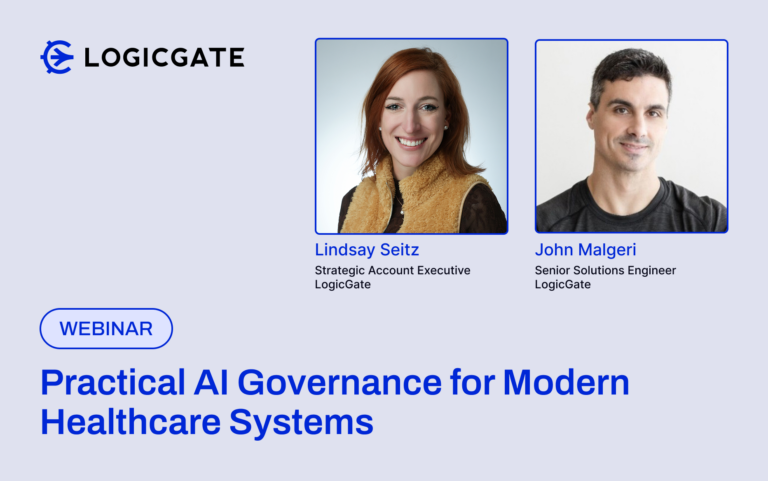
That tension was the starting point for LogicGate’s recent webinar, Practical AI Governance for Modern Healthcare Systems. In a live poll, roughly half of attendees had a defined review process, yet visibility into every AI vendor in use was still spotty.
Spreadsheets and hand-keyed requests were never built for dozens of AI requests a week. When nobody follows up, issues slip through, and the same vendor gaps reappear at the next review.
What Does Shadow AI Look Like in a Real Health System?
Consider Good Governance General Hospital, a fictional healthcare company with 12 hospitals and 600 outpatient physicians. Its ambulatory-care leader finds an AI scribe that promises a 40% cut in documentation time and wants it live quickly.
A physician starts a free trial in live patient encounters. Conversation audio and protected health information (PHI) reach the vendor before any security, legal, or business associate agreement (BAA) review.
The intent was good, but HHS guidance on HIPAA business associates generally requires a BAA before a vendor handles PHI on your behalf. That one request also raises a different question for every function:
- Clinical leadership: How accurate are the notes, and who reviews them?
- Legal: What patient data does the vendor collect, retain, or use for training?
- IT and security: Which model and EHR integration are involved?
- Procurement and risk: Which vendor, policies, and risks apply?
Underneath those questions sits a bigger one that most organizations answer too late: who owns approval and ongoing oversight?
How Do You Govern AI Without Slowing It Down?
The answer is a repeatable path with four steps, and an AI Governance Agent can handle much of the legwork along the way.
- Capture. Bring every AI use case into one intake, so requests from clinical, IT, and administrative teams stop arriving through email and side conversations.
- Assess. Link each use case to its model, vendor, risks, frameworks, and policies, so reviewers see the full picture before they weigh in.
- Review and approve. Route the request to the right owners in clinical, legal, security, and procurement, and record each decision.
- Monitor. Track usage, performance, and review efficiency after approval, because oversight does not end when the contract is signed.
In practice, the agent picks up each new request and completes triage in under a minute. It fills in key fields, links the controls that could be affected, and generates an AI assessment. It also surfaces the third party behind the model, along with vendor risk and the types of data involved.
Related risks and policies come along automatically, and the agent scopes the right assessment and assigns it to the right owner. Every action is auditable, with the agent’s rationale and a confidence score. A person still completes the assessment and makes the call.
What Do Healthcare Teams Gain From Agentic AI Governance?
The first gain is speed without guesswork. Reviews move faster because intake, control mapping, and assessment scoping are handled before a human ever opens the request.
The second is accountability you can show an auditor. Decisions are documented, owners are clear, and dashboards show volume, stage, and risk, so teams can see what is pending and where.
The third is visibility that starts early. Mapping requests to frameworks such as the NIST AI Risk Management Framework keeps decisions consistent, and well-intentioned shadow AI gets caught before it reaches patients.
What Should You Do Next?
You do not need a finished program to start. Two moves from the webinar are worth making this week:
- Set up an internal discovery meeting with your IT, Security, and Legal counterparts.
- Review current vendor contracts for undisclosed AI clauses or training rights.
To see the full webinar, watch the on-demand recording here: AI Governance for Healthcare
Frequently Asked Questions
What Is AI Governance in Healthcare?
It is the set of policies, reviews, and oversight that decide which AI tools a health system may use. It also defines which data those tools can touch and who monitors them after approval.
Do GRC Agents Replace Human Reviewers?
No. Agents triage intake, map controls, risks, and policies, and scope assessments. People make the final decision.
Why Is a Free AI Trial a HIPAA Risk?
A trial in live patient encounters can send PHI to a vendor before a BAA, security review, or legal sign-off. A single governed intake prevents that exposure.