Formula 1 and GRC share one principle: risk is managed continuously. Both worlds run on connected data, clear governance, and a human making the final call. Both operate at high speed, under strict rules, with severe consequences for a missed signal.
LogicGate is hosting a networking reception at F1 Arcade Boston on January 14, 2027, offering full-motion F1 racing simulators. The setting is a fitting reminder that a race team and a risk team aren’t so different.
How Do Formula 1 and GRC Face the Same Kind of Risk?
LogicGate’s AI GRC platform gives GRC risk management teams one connected view of risk so they have full context for every decision. The table below maps six F1 risk factors to their GRC equivalents and the LogicGate capability that addresses each one.
| F1 Risk Factor | GRC Equivalent | How LogicGate Responds |
| Live car telemetry | Continuous control monitoring | Automated Control Testing moves reviews from point-in-time to continuous |
| New FIA regulations | Evolving frameworks and regulatory requirements | Solutions mapped to frameworks such as NIST CSF |
| Approved parts suppliers | Third-party and vendor risk | Third-Party Risk Management application |
| Pit wall strategy calls | Executive risk decisions | Reporting and analytics built on connected data |
| Driver safety systems like the halo | Preventive and detective controls | Controls Compliance application |
| Engineering data spread across teams | Siloed risk registers | No-code, flexible graph database |
How Does Real-Time Telemetry Compare to Continuous Risk Monitoring?
An F1 team does not wait for the checkered flag to learn that a tire is degrading. Telemetry streams from the car to engineers during the race. They can act while a fix still matters.
Many GRC programs still work the opposite way. Control testing happens once a year, and evidence arrives in spreadsheets weeks after the fact.
Automated Control Testing closes that gap. AI tests uploaded evidence and returns a pass, fail, or incomplete result with its rationale, ready for human validation. That shifts control reviews from point-in-time checks to continuous insight.
What Do F1 Safety Rules Reveal About Governance and Control Design?
Every major F1 safety rule traces back to a hard lesson. The halo, a titanium cockpit protection structure, became mandatory in 2018 after years of testing. The FIA concluded it offered the best overall safety performance among the devices it evaluated.
The rollout also shows how controls meet resistance. Drivers and fans criticized the halo’s looks and visibility at first. The FIA held firm because the safety evidence was strong.
GRC leaders face the same dynamic when a new control slows a business team down. Cross-functional Governance works when the rationale is documented and the evidence is visible.
NIST reinforced this in February 2024 by adding a sixth function, Govern, to Cybersecurity Framework 2.0. The Govern function informs how an organization carries out the other five functions: Identify, Protect, Detect, Respond, and Recover. It covers strategy, roles and responsibilities, policy, oversight, and supply chain risk management.
How Is the F1 Supply Chain Like Third-Party Risk?
No team builds every part of its car. The FIA approved the suppliers that manufactured the halo, so every team’s safety-critical component met the same specification.
Enterprises depend on vendors the same way, but each vendor can introduce its own exposure. NIST CSF 2.0 gives supply chain risk its own category, GV.SC, within the Govern function.
LogicGate’s Third-Party Risk Management application helps teams identify, assess, and mitigate vendor risk in one place. AI autofill can complete intake forms and assessments from existing documentation, and teams can toggle it to match internal AI policy. Forrester named LogicGate a Leader in The Forrester Wave: Third-Party Risk Management Platforms, Q1 2026.
Why Does the Pit Wall Need One Source of Truth?
On race day, strategists, engineers, and drivers work from the same live picture. If the tire data said one thing and the weather model said another, the call would be a guess.
Risk teams often decide this way. Enterprise risk, cyber risk, vendor findings, and control results sit in separate tools. Leaders see fragments instead of the whole race.
Connected risk fixes this by linking every risk, control, vendor, and issue in one data model. A cyber finding on a vendor should update the enterprise risk register without anyone re-keying it.
How Does LogicGate Connect Risk Across the Enterprise?
LogicGate applications are built across a connected AI GRC platform. The platform links data across use cases – like enterprise risk management, third-party risk, and cyber risk – giving teams one connected view of risk.
Vendor findings roll up into enterprise-wide risk registers, which gives leaders cross-domain reporting from one source of truth. Risk teams can also change workflows without waiting on IT or professional services.
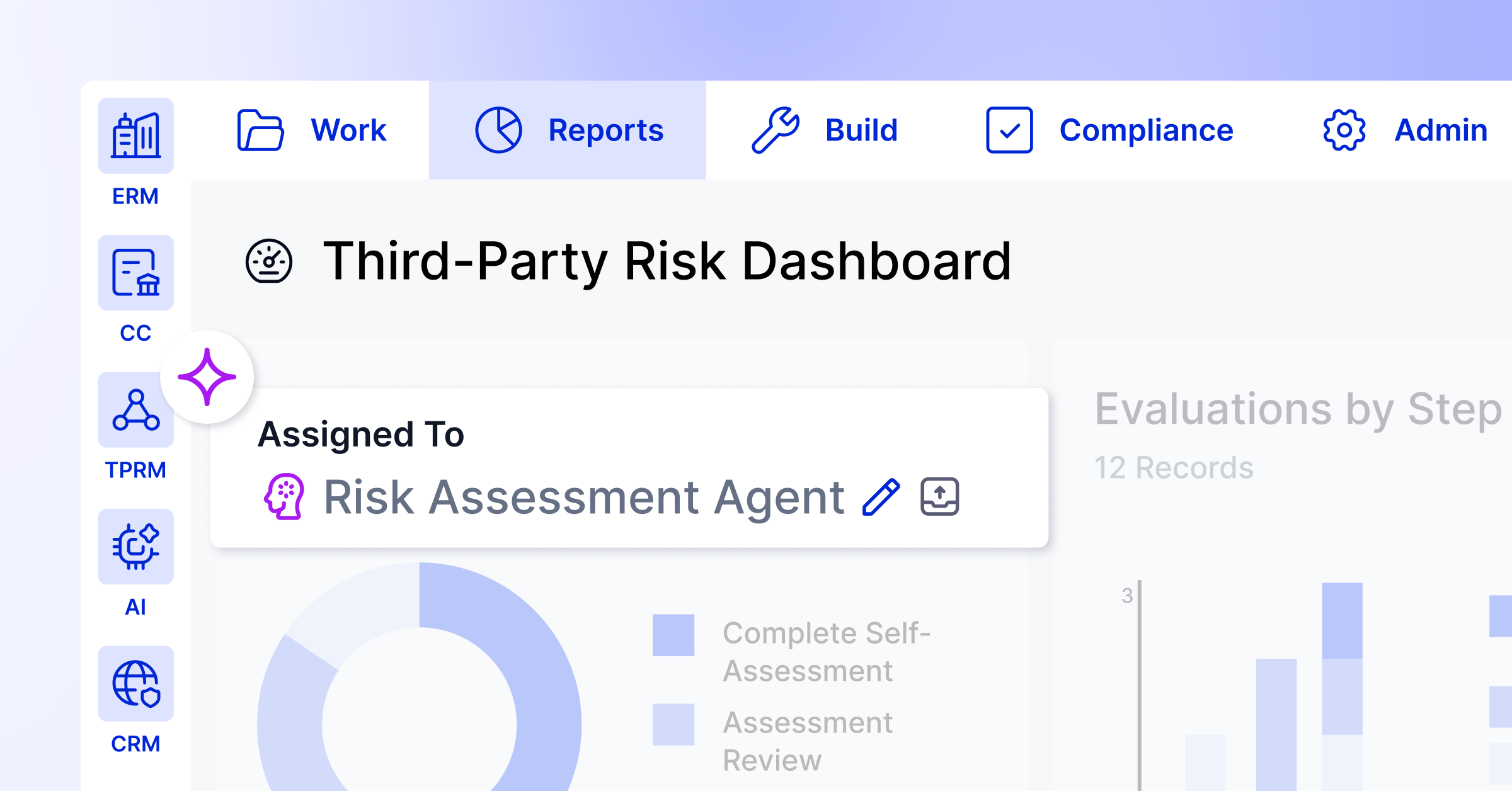
GRC Agents extend this model and are live across four applications: Third-Party Risk Management, Enterprise Risk Management, AI Governance, Business Continuity Management. Your risk professionals still own the decisions, just as the driver and pit wall own the race.
Where Can You See Connected Risk in Action?
Join LogicGate at F1 Arcade Boston on January 14, 2027, for happy hour and full-motion F1 racing simulators. Meet fellow GRC leaders in a setting that proves speed and safety are not opposites. Register here!
What Questions Do Leaders Ask About F1 and GRC Risk?
What Is the LogicGate Event at F1 Arcade Boston?
LogicGate is hosting a happy hour at F1 Arcade Boston on January 14, 2027 from 5:00 – 8:00 PM EST. It’s a great opportunity to network with fellow GRC professionals and get behind the wheel with full-motion F1 racing simulators.
How Is GRC Risk Similar to Formula 1 Risk?
Both depend on live data, strict rules, and fast decisions. In F1, telemetry and FIA regulations guide the team. In GRC, continuous monitoring and frameworks such as NIST CSF 2.0 play that role.
What Is Connected Risk Management?
Connected risk management links risks, controls, vendors, and issues in one data model. Teams see how a change in one area affects the others. Risk Cloud’s no-code, flexible graph database supports this approach.
How Does LogicGate Support Continuous Control Monitoring?
Automated Control Testing uses AI to test uploaded evidence and return a pass, fail, or incomplete result with a rationale. Human reviewers validate the outcome. This moves control reviews from point-in-time checks toward continuous insight.
Does AI Replace Risk Professionals in LogicGate?
No. LogicGate pairs AI with human ownership, so people validate results and make the final call. GRC Agents log every action, so teams can audit what an agent did.
What Is the NIST CSF 2.0 Govern Function?
Govern is the sixth function in NIST Cybersecurity Framework 2.0, released in February 2024. It informs how an organization carries out Identify, Protect, Detect, Respond, and Recover. It covers strategy, roles, policy, oversight, and supply chain risk management.