TL;DR: LogicGate has been named a Leader in the IDC MarketScape: Worldwide Third-Party Risk Management Software 2026 Vendor Assessment. We believe this recognition highlights the platform’s ability to transform traditional, reactive risk management into a dynamic, continuous program.
Most third-party risk programs were built for a slower era. Vendor networks grow every quarter, but the reviews meant to keep them in check are still static, point-in-time exercises: a questionnaire here, a spreadsheet update there, revisited once a year if you’re lucky. That gap between how fast your vendor ecosystem moves and how fast your risk team can actually assess it is where exposure lives.
Third-party networks aren’t shrinking. Every new SaaS tool, subprocessor, and outsourced function adds another vendor a risk team has to track, and every one of those vendors can change its own risk profile without telling you. A questionnaire from six months ago doesn’t tell you much about a vendor’s security posture today. Regulators have noticed the same gap, which is part of why continuous, evidence-based vendor oversight is becoming the expectation rather than a nice-to-have.
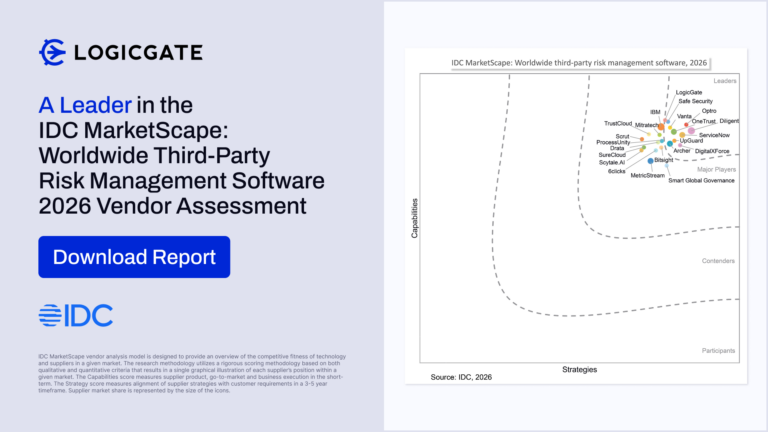
We’re proud to share that IDC has recognized LogicGate for closing that gap. LogicGate has been named a Leader in the IDC MarketScape: Worldwide Third-Party Risk Management Software 2026 Vendor Assessment. We believe we received this recognition because of our differentiation through intentional AI and our agentic roadmap.
What Is the IDC MarketScape for Third-Party Risk Management Software?
The IDC MarketScape is an independent vendor assessment from IDC, a global research and analyst firm that evaluates technology providers across a given market. Rather than a simple feature checklist, the model scores vendors on both capabilities (how well a platform executes today) and strategy (how well its roadmap aligns with where the market is headed), then plots each vendor’s position on a single comparative graphic.
For this assessment, IDC evaluated third-party risk management (TPRM) software providers across the full vendor landscape, looking at how each platform helps risk teams manage vendor relationships from onboarding through ongoing monitoring.
Why LogicGate Was Named a Leader
A few things set LogicGate apart in this evaluation:
Continuous monitoring, not point-in-time reviews. LogiGate’s built-in AI skills handle automated control testing by evaluating vendor control evidence as soon as it’s uploaded, replacing the once-a-year snapshot with an ongoing, machine-speed review process.
No-code configurability. Risk teams can build and adjust TPRM workflows themselves, without waiting on IT tickets or professional services engagements. That independence shows up directly in total cost of ownership.
Connected risk visibility. TPRM doesn’t live in a silo on Risk Cloud®. It’s natively connected to enterprise risk, audit, and compliance data, so a vendor’s risk profile is part of one unified view instead of in a separate system nobody else can see.
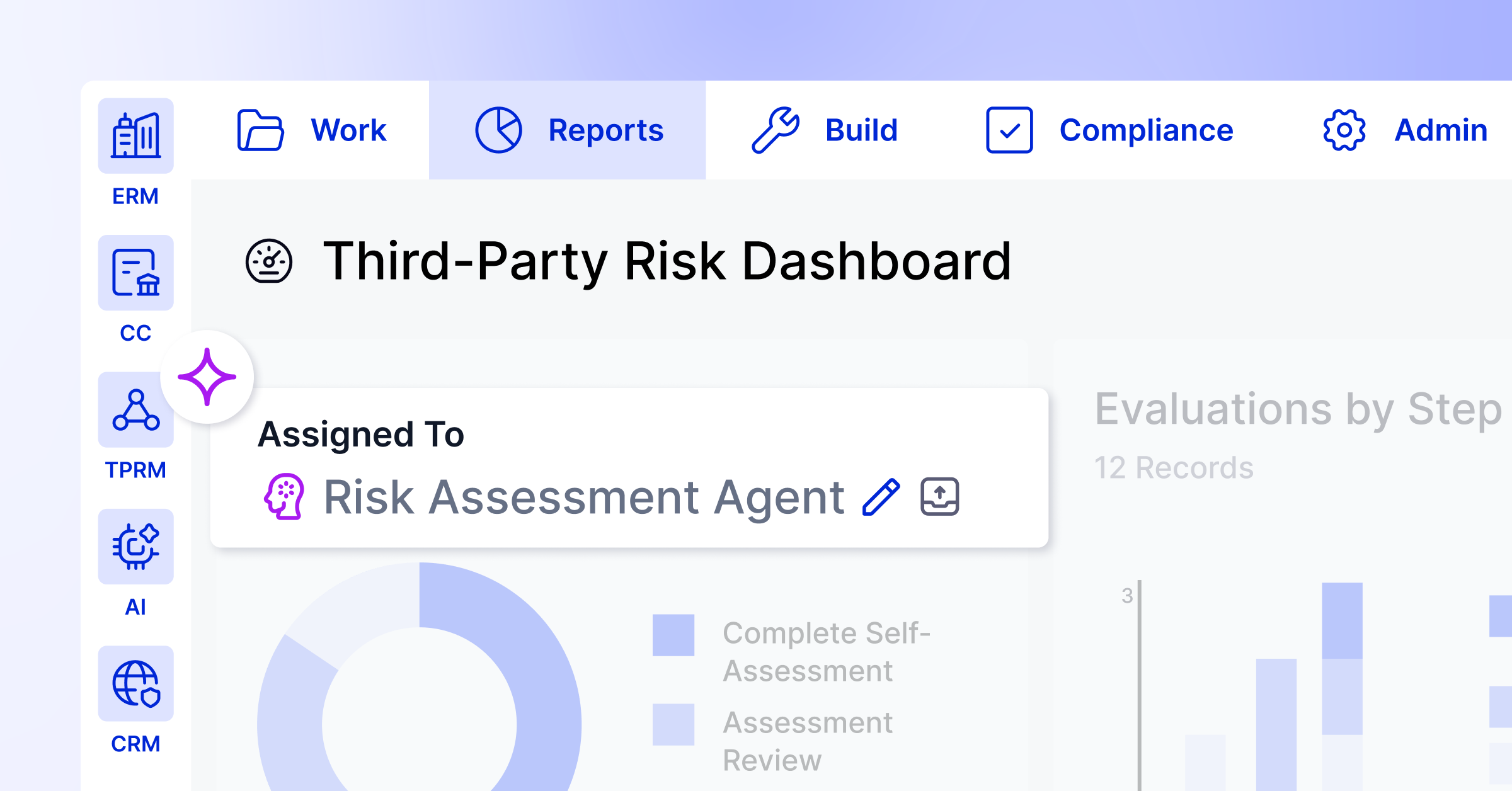
AI that’s built in, not bolted on. AI skills come standard inside the platform at no additional cost, and new GRC Agents built specifically to automate TPRM decision-making are now available.
IDC’s analysis calls out LogicGate’s approach to automated control testing directly. Research Director and lead analyst Phil Harris writes: “LogicGate AI Automated Control Testing uses agentic actions to immediately test vendor control evidence upon upload, providing pass/fail/incomplete results with testing rationale and observable outputs ready for human-in-the-loop validation — shifting vendor compliance evaluation from point-in-time to continuous, machine-speed review.”
The report also points to LogicGate’s usability advantage: “LogicGate’s no-code philosophy reduces professional services dependency, lowering total cost of ownership for self-sufficient risk teams.”
This is LogicGate’s third analyst Leader recognition in 2026, following placements in the Forrester Wave for Third-Party Risk Management Platforms and the Gartner® Magic Quadrant™ for GRC Tools, Assurance Leaders.
What This Means for Your Risk Team
If your TPRM program still runs on annual questionnaires and manual follow-ups, the shift IDC is pointing to is straightforward: move from static, point-in-time assessments to continuous monitoring. That means fewer surprises between review cycles, faster visibility when a vendor’s risk profile changes, and less time spent chasing paperwork instead of making decisions.
We believe this recognition reflects that shift, and specifically our intentional approach to AI and the agentic TPRM roadmap behind it. Automating the busywork of vendor intake and assessment isn’t the end goal. Giving risk teams the time and visibility to act on what actually matters is.
Picture a critical vendor whose control evidence gets flagged the moment it’s uploaded, not six months later during the next scheduled review. That’s the difference between a program that reacts to vendor risk and one that stays ahead of it.
Get the Full IDC MarketScape Report
The IDC MarketScape: Worldwide Third Party Risk Management Software 2026 Vendor Assessment is available now. Read the full report for IDC’s complete analysis of the TPRM vendor landscape, including the criteria behind LogicGate’s Leader placement. Get the full report.
Ready to Move Beyond Point-in-Time Vendor Reviews?
Third-party risk isn’t getting simpler, and neither is the regulatory pressure around it. If your team is still stitching together vendor risk visibility from spreadsheets and annual reviews, there’s a better way to run it.
Read the full IDC MarketScape report to see why LogicGate was named a Leader placement, then request a demo with a LogicGate GRC expert to see AI skills and our TPRM Agents in action.
Frequently Asked Questions
It’s an independent evaluation from IDC, a global technology research and analyst firm, that assesses third-party risk management software providers on both current capabilities and strategic direction, then maps each vendor’s position on a comparative graphic.
A Leader placement means IDC scored LogicGate among the top providers evaluated in this market, based on the firm’s independent research and scoring methodology. It doesn’t imply endorsement of every use case; it reflects IDC’s assessment as of the report’s publication date.
LogicGate’s placement reflects its continuous, AI-driven approach to vendor control testing, its no-code configurability, and its native connectivity across TPRM, enterprise risk, audit, and compliance data. As the report states, “LogicGate’s no-code philosophy reduces professional services dependency, lowering total cost of ownership for self-sufficient risk teams.”
It’s a Risk Cloud capability that reviews vendor control evidence as soon as it’s uploaded, rather than waiting for a scheduled review cycle, so risk teams get continuous visibility instead of a once-a-year snapshot. As IDC’s report states: “LogicGate AI Automated Control Testing uses agentic actions to immediately test vendor control evidence upon upload, providing pass/fail/incomplete results with testing rationale and observable outputs ready for human-in-the-loop validation — shifting vendor compliance evaluation from point-in-time to continuous, machine-speed review.”
The IDC MarketScape: Worldwide Third-Party Risk Management Software 2026 Vendor Assessment is available now. Get your copy here.
Risk Cloud is LogicGate’s AI GRC platform for enterprise governance, risk, and compliance teams. It gives teams a centralized, connected view of risk and compliance data through a no-code architecture, with AI capabilities woven into core workflows.
A point-in-time review checks a vendor’s risk posture once, usually on an annual cycle, and treats that snapshot as current until the next review. Continuous monitoring evaluates vendor control evidence as it changes, so a shift in risk shows up as soon as it happens instead of surfacing months later.
“Worldwide Third Party Risk Management Software Vendors 2026 Vendor Assessment”, September 2026, IDC # US53007725