Understanding how to manage AI risks is essential as AI adoption accelerates faster than most organizations can govern it. Employees are already using generative AI tools. Vendors are embedding AI into products you rely on, and regulators are racing to catch up with frameworks that carry real enforcement teeth.
The gap between AI capability and AI oversight creates exposure that lands squarely on risk and compliance teams. Knowing how to manage AI risks is now a core competency for these programs
This blog walks through the major categories of AI risk and the frameworks shaping governance requirements. It also covers a practical approach to building an AI risk management program that scales with your organization.
What Is AI Risk Management?
AI risk management is the ongoing process of finding, measuring, and reducing threats that come from artificial intelligence systems. Unlike traditional IT risk, AI risk covers a wider range of concerns: security holes, biased decisions, privacy violations, and model degradation.
The point isn’t to avoid AI altogether.Organizations that try to ban AI usually find:
- Employees use it anyway, just without any guardrails.
- Competitors are using AI to unlock new competitive advantages.
- Company goals and required operational efficiencies aren’t possible without AI.
Instead, AI risk management helps you adopt AI safely while protecting your organization from legal trouble, financial loss, and reputational damage.
What makes AI risk different from other technology risks? Three things stand out.
First, AI systems learn and change over time, so a model that works perfectly today might produce unreliable results six months from now. Second, AI decisions can be hard to explain, which creates accountability problems when something goes wrong. Third, AI depends heavily on data, and data carries its own privacy and quality risks that flow directly into AI outputs.
The Main Types of AI Risks Your Organization Faces
AI risks don’t fit into a single bucket. They span security, ethics, operations, and compliance, and they often overlap in ways that make them tricky to manage. Here’s a breakdown of the major categories.
1. Security and Adversarial Risks
Adversarial risks target the AI system itself. Attackers can feed manipulated inputs to trick models into wrong outputs or poison training data to corrupt model behavior. They can also exploit prompt injection vulnerabilities in generative AI tools.
Prompt injection is worth explaining: it’s when someone crafts an input that causes an AI to ignore its instructions and do something unintended. If you’ve seen examples of people getting chatbots to reveal their system prompts, that’s prompt injection in action. Security teams now treat AI models as attack surfaces, just like servers or applications.
2. Data Privacy and Confidentiality Risks
AI systems consume enormous amounts of data, and that creates exposure. Training data might contain personal information that surfaces unexpectedly in outputs. Employees might paste sensitive customer data into public AI tools without thinking about where that data goes.
Privacy regulations like GDPR and CCPA apply to AI the same way they apply to any other data processing. The difference is that AI can leak information in surprising ways, through model outputs rather than traditional database breaches.
3. Bias, Fairness, and Ethical Risks
Algorithmic bias happens when AI systems produce outcomes that unfairly disadvantage certain groups. This can stem from skewed training data, flawed model design, or feedback loops that amplify existing inequities over time. Research from Wharton on AI risk governance provides further context on managing these concerns.
Fairness isn’t just an ethical concern. It’s a legal and reputational one. Regulators and customers increasingly expect organizations to show that their AI systems treat people equitably, and the consequences of getting this wrong can be severe.
4. Operational and Model Performance Risks
AI models degrade. Model drift occurs when real-world data no longer matches the data a model was trained on, causing accuracy to decline. A fraud detection model trained on last year’s patterns might miss new fraud techniques entirely.
Without continuous monitoring, you won’t know performance has dropped until something breaks. By then, the damage is already done.
5. Regulatory and Compliance Risks
The regulatory landscape for AI is moving fast. The EU AI Act classifies AI systems by risk tier and places strict requirements on high-risk applications. Other jurisdictions are developing their own frameworks.
Non-compliance carries real consequences: fines, operational restrictions, and reputational harm. Organizations serving global customers face the added challenge of navigating multiple regulatory regimes at once.
6. Reputational and Strategic Risks
AI failures make headlines. A biased hiring algorithm, a chatbot generating offensive content, or a model making costly errors can damage brand trust for years.
There’s also risk in moving too slowly. Organizations that delay AI governance may find themselves unable to adopt AI safely when competitors have already built mature programs.
The Most Urgent AI Risks Facing Enterprises Today
While all AI risks matter, a few demand immediate attention:
- Generative AI misuse: Employees use AI tools, like ChatGPT or Copilot, without formal policies. This creates data leakage and compliance gaps.
- Third-party AI risk: Vendors embed AI in products you use, creating inherited risks without visibility.
- Shadow AI: Business units adopting AI tools outside IT and compliance oversight. You can’t govern what you can’t see.
- Regulatory uncertainty: Requirements are changing faster than many organizations can adapt. What’s compliant today might not be tomorrow.
Key AI Risk Management Frameworks and Regulations
Frameworks give structure to AI governance. They provide common language, define accountability, and help demonstrate due diligence to regulators and auditors.
NIST AI Risk Management Framework
Developed by the National Institute of Standards and Technology (NIST), the NIST AI RMF is one of the most widely referenced frameworks in the United States. It is not a regulation with mandatory compliance requirements or associated penalties for non-adherence. Instead, it serves as a guide for organizations to build trust and ensure the responsible development and use of AI. It organizes AI risk management into four core functions:
- Govern: Build internal culture, set policies, and define who’s accountable for AI decisions.
- Map: Identify the purpose, context, and stakeholders affected by each AI system.
- Measure: Test AI systems for accuracy, security flaws, bias, and other risks on an ongoing basis.
- Manage: Take action based on findings, whether that means fixing issues, accepting residual risk, or deciding not to deploy.
ISO/IEC 42001
ISO/IEC 42001 is the international standard for AI management systems. It provides a certification path for organizations wanting third-party validation of their AI governance practices. While not yet a harmonized standard in the Official Journal of the European Union for the EU AI Act, ISO 42001 provides the structural foundation for the Article 17 Quality Management System (QMS) required for high-risk AI providers. It mirrors the Act’s emphasis on risk management, data governance, and post-market monitoring. For global enterprises, ISO certification can simplify conversations with regulators and customers across different jurisdictions.
The EU AI Act
The EU AI Act takes a risk-based approach, classifying AI systems into four tiers:
| Risk Level | Examples | Requirements |
| Unacceptable | Social scoring, manipulative AI | Prohibited |
| High-risk | Hiring tools, credit scoring | Strict compliance obligations |
| Limited | Chatbots, emotion recognition | Transparency requirements |
| Minimal | Spam filters, AI-enabled games | No specific requirements |
If you serve EU customers, this regulation applies regardless of where your organization is headquartered. Learn more about what organizations need to know about the EU AI Act.
Sector-Specific and Emerging Guidance
Financial services, healthcare, and other regulated industries have additional AI governance requirements. The SEC, OCC, FDA, and other regulators are all developing AI-specific guidance. Staying current requires ongoing monitoring of regulatory developments in your industry.
Who Owns AI Risk Across the Enterprise
AI risk doesn’t belong to a single team. It spans technology, legal, compliance, and business functions. Clear ownership prevents gaps and finger-pointing when something goes wrong.
The CISO and Security Team
Security teams own adversarial threats, model security, and infrastructure protection. They’re responsible for treating AI systems as attack surfaces and integrating AI security into existing vulnerability management.
The Chief Data and Privacy Officer
Data leaders own data quality, privacy compliance, and responsible data use in AI training and outputs. They ensure AI systems don’t create new privacy exposures or violate data handling policies.
The Chief Compliance Officer and Legal
Compliance and legal teams own regulatory compliance, contract review for AI vendors, and liability considerations. They translate regulatory requirements into operational policies.
Internal Audit and the Board
Internal audit provides independent assurance that AI governance controls are working. The board needs visibility into AI risk posture, not technical details, but business impact and strategic implications.
How to Manage AI Risks: Building a Risk Management Framework
Frameworks only matter if you put them into practice. Here’s a step-by-step approach.
1. Inventory Every AI System in Use
Learning how to manage AI risks starts with knowing what AI systems exist in your environment.
You can’t manage what you can’t see. Start by cataloging all AI systems, both internally developed models and third-party AI embedded in vendor tools. This inventory becomes your foundation for everything that follows.
The hardest part of this step is shadow AI, the tools employees are using without formal approval. To make the unknowable knowable, take these three steps:
- Run an expense audit: Scan corporate card and reimbursement data for individual subscriptions to tools like ChatGPT Plus or Claude Pro.
- Monitor web traffic: Use your Cloud Access Security Broker (CASB) or web gateways to flag traffic heading to known generative AI domains.
- Offer “AI Amnesty”: Send a non-punitive internal survey asking teams what AI tools currently make their jobs easier, framing it as research to buy secure, enterprise-wide licenses.
2. Classify AI Systems by Risk Tier
Not all AI systems carry the same risk. A spam filter and a credit decisioning model require different levels of governance. Classify systems based on use case, data sensitivity, and potential impact.
3. Map AI Risks to Controls and Policies
Connect identified risks to specific controls, policies, and responsible owners. This creates accountability and audit trails. When a regulator asks how you’re managing bias risk, you can point to documented controls and evidence.
4. Assess and Quantify AI Risk
Risk assessment can be qualitative (high/medium/low ratings) or quantitative (financial impact modeling). These assessments should be standardized to ensure consistent quality and outputs, as well as scoped appropriately based on risk tier. Quantitative approaches like Monte Carlo simulations help translate AI risks into business terms that executives understand.
5. Monitor AI Systems Continuously
AI risk management isn’t a one-time project. Models drift, regulations change, and new vulnerabilities emerge. Continuous monitoring catches problems before they become incidents. Establish automated alerts and review cycles for three specific triggers:
- Input/Output Flags: Use Data Loss Prevention (DLP) tools to catch employees pasting PII or sensitive code into AI prompts, and monitor outputs for sudden spikes in hallucinations.
- Performance Drift: Track the accuracy of your models over time. If a customer service bot suddenly starts giving incorrect refund advice, you need an automated alert, not a customer complaint.
- Vendor ToS Changes: Third-party AI tools update their terms constantly. Assign a reviewer to monitor if an approved vendor quietly opts your company data into their training pipeline during a routine update.
6. Report AI Risk to Executives and the Board
Executives and board members don’t need technical details. They need to understand business impact. Dashboard reporting that connects AI risks to financial exposure and compliance status enables better decisions at the top.
You cannot paint an accurate picture for the board if you are tracking AI in a siloed spreadsheet. AI governance is inextricably linked to your broader risk ecosystem. To report effectively, you need a holistic platform that ties AI directly into:
- Third-Party Risk (TPRM): Because an AI vendor’s security posture or data breach immediately becomes your own exposure.
- Cyber Risk & Incidents: To link a data leak or prompt injection attack directly back to the compromised model and track the remediation.
- Regulatory Compliance: To map specific AI deployments against emerging frameworks (like the EU AI Act) and existing privacy laws.
- Controls and Policies: To demonstrate that your “Acceptable AI Use” policy is actually backed by measurable, enforceable controls.
When the board asks, “What is our AI exposure?”, an interconnected platform allows you to answer with a single, unified narrative rather than cobbling together disconnected reports from IT, legal, procurement, and security.
How to Manage Generative AI and Third-Party AI Risks
Generative AI deserves special attention because it’s already everywhere and creates unique exposures around data leakage and output reliability.
- Acceptable use policies: Define what AI tools employees can use, for what purposes, and with what data.
- Vendor AI due diligence: When evaluating vendors, ask how they’re using AI in their products and assess their governance practices.
- Data handling rules: Prevent sensitive data from being entered into public AI tools through both policy and technical controls.
- Output validation: Require human review of AI-generated content before use in decisions or external communications.
Start small. Test generative AI in low-risk use cases before expanding to higher-stakes applications.
How to Use AI and Automation to Scale AI Risk Management
Here’s the interesting part: AI can help you manage AI risk. Automation addresses the volume challenges that make manual approaches unsustainable, while purpose-built AI agents handle the heavy lifting of triage and analysis.
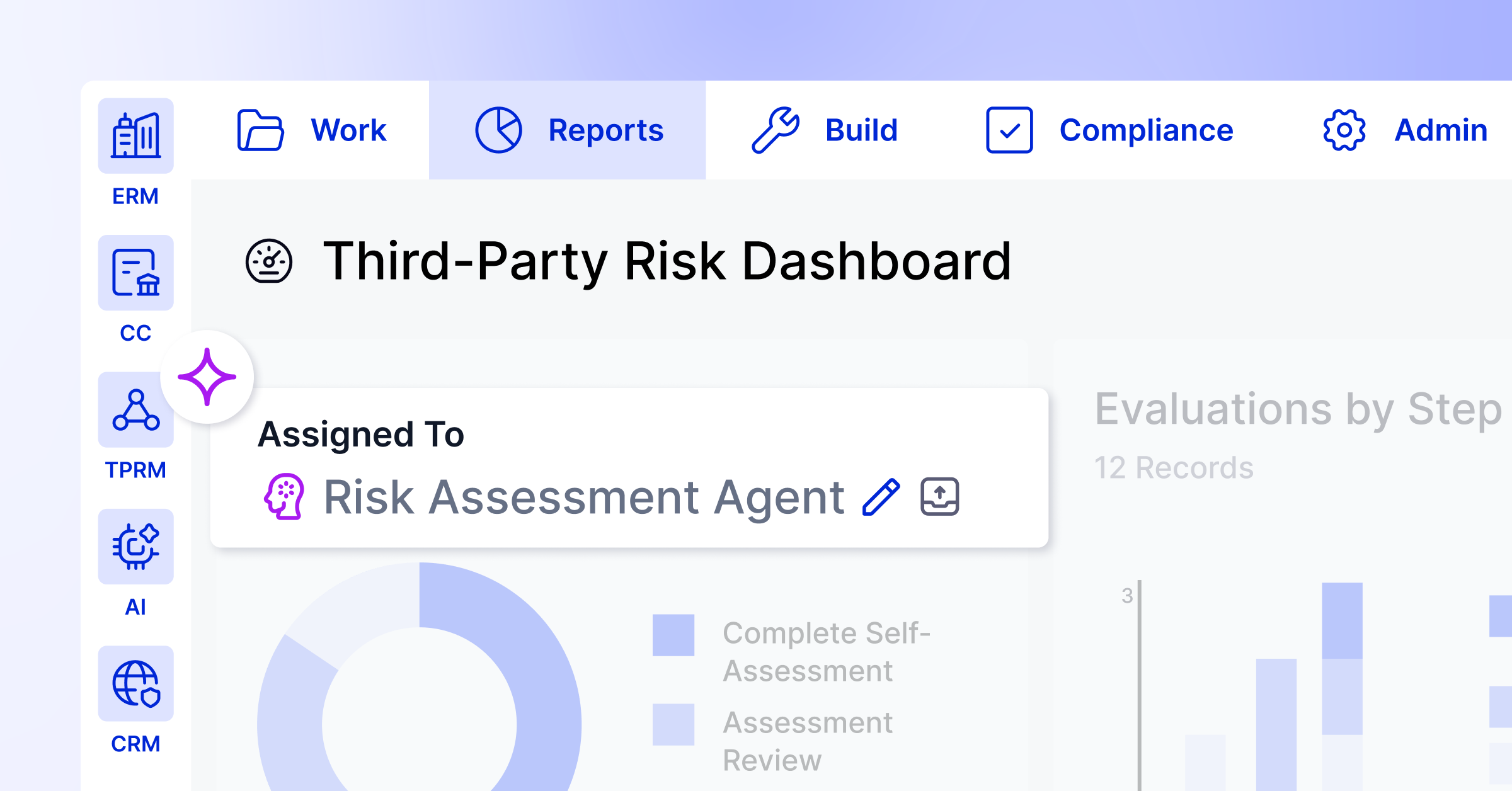
- Agentic Intake & Triage: AI Governance agents can pre-fill intake records, review supporting documents, categorize by risk or type, and suggest assessment routes. This condenses weeks of manual review into minutes, keeping your team focused on top priorities.
- Agentic Assessments & Gap Analysis: Instead of starting from scratch, agents consistently evaluate AI use against your defined risk framework, populate fields with clear rationales, identify control gaps, and automatically create linked finding and mitigation records for human review.
- Dynamic Relational Linking: AI-powered linking keeps your AI use cases contextually connected to relevant third parties, risks, controls, policies, systems, and processes, ensuring no model is evaluated in a vacuum.
- Automated Control Testing: Pull compliance artifacts on a set cadence and let the platform complete first-pass evidence reviews, automatically alerting your team to issues or findings.
- Executive Insights via Chat: Transform complex data across AI governance and related domains into an intuitive chat experience that builds executive-ready reports and dynamically flags AI models and use cases requiring immediate attention.
The key is maintaining human oversight. AI handles high-volume, low-risk tasks, but humans remain accountable for decisions that matter.
Operationalize AI Risk Management With a Connected GRC Platform
Spreadsheets and siloed tools can’t scale with AI risk complexity. Organizations that understand how to manage AI risks effectively invest in connected platforms. See why GRC automation goes beyond spreadsheets.
As your AI portfolio grows, you need a platform that connects AI governance to your broader enterprise risk, compliance, and audit programs.
A modern GRC platform brings AI risk management into the same environment where you manage third-party risk, regulatory compliance, and controls testing. That means consistent workflows, centralized data, and unified reporting rather than another disconnected point solution.
LogicGate’s Risk Cloud® includes purpose-built AI Governance capabilities. It helps you inventory AI systems, assess risks, manage policies, and demonstrate compliance with frameworks like the NIST AI RMF and EU AI Act. Because it’s part of a connected GRC platform, your AI risk data flows into enterprise-wide dashboards and board reporting. Request a demo today.
Frequently Asked Questions About AI Risk Management
The 30% rule suggests that roughly 30% of AI risk management effort continues after deployment, covering ongoing monitoring, model maintenance, and incident response. It emphasizes that AI governance is a lifecycle activity, not a one-time assessment.
Start with an inventory of all AI systems in use, establish acceptable use policies for generative AI, and prioritize governance for high-risk applications. Quick wins often come from addressing shadow AI and implementing basic controls for employee use of public AI tools.
The most frequently cited AI risks are data privacy breaches, algorithmic bias, and security vulnerabilities including adversarial attacks. Regulatory non-compliance and operational failures from model drift are also common.
Yes. AI can automate evidence collection, assist with risk assessments, detect anomalies, and scale monitoring across large AI portfolios. However, human oversight remains essential for accountability, especially in regulated contexts.
AI risk extends beyond cybersecurity to include ethical concerns like bias, explainability requirements, model-specific vulnerabilities, and evolving AI-specific regulations that traditional cyber frameworks don’t address. For more on cyber risk, see how to manage cyber risk in your organization.