TL;DR: “Vibe coding” means building tools by prompting an AI, not through engineering discipline. Retail, hospitality, healthcare, and manufacturing teams are trying it on governance, risk, and compliance (GRC) as regulations pile up. It fails because a holistic program needs a single source of truth, not a folder of one-off prompts. A connected GRC platform with governed AI skills, agents, and years of proven implementations can produce what a business, auditors, and boards all require.
What Does It Mean to “Vibe Code” a GRC Program?
A risk lead feels pressure to “do something with AI.” They prompt a general-purpose model to draft a policy, a control matrix, or a risk score. The output lands in a spreadsheet, a wiki, or a chat thread.
Then another team does the same thing, separately. Compliance builds one tracker, security builds another, and operations builds a third. Nothing connects them, and no one owns the whole picture.
That is vibe-coded GRC. It looks like progress in a demo. It falls apart the moment a regulator, customer, or board member asks for the record behind a decision.
Retail, hospitality, healthcare, and manufacturing are especially exposed here. Many of these teams were never staffed like banks, so GRC often lived in spreadsheets for years. Now the regulatory load has caught up, and the temptation to patch the gap with AI is strong.
Where Does That Data Go Once You Prompt It?
The exposure does not start with the output. It starts the moment someone pastes a control gap, a vendor’s contract terms, or an incident summary into a personal AI account instead of the one the company actually sanctions.
- OpenAI trains on ChatGPT, Sora, and Operator conversations by default, and a user has to actively opt out through its privacy portal to stop it.
- Google is more direct about the risk: its own Gemini privacy hub tells users outright not to enter confidential information they would not want a reviewer to see or Google to use to improve its services. A subset of chats gets reviewed by human contractors, and reviewed data can sit on Google’s servers for up to three years.
- Anthropic now asks consumer users to make an explicit choice about training instead of defaulting to it, but saying yes extends retention on those chats to five years.
None of that applies once a company signs an enterprise agreement. ChatGPT Team, ChatGPT Enterprise, and the API do not train on inputs or outputs by default. The same split holds for Google Workspace, Google Cloud, and Claude for Work. The entire difference between a governed AI seat and a personal one is a contractual guarantee against training and long-term retention (or the absence of one).
A risk lead who vibe codes a control matrix on a personal account is not only producing an ungoverned spreadsheet. They may be handing a vendor’s contract terms, a customer’s data, or the company’s own control gaps to a third party’s training pipeline, with no audit trail showing it ever happened. That is a data governance failure before it is ever a GRC platform problem.
Why Is There Always Too Much Risk to Handle by Hand?
No matter your industry, the rules never stop changing. New privacy laws, cyber mandates, and AI regulations arrive faster than any team can staff for. The obligations always outrun headcount, so shortcuts feel reasonable in the moment.
The specifics differ by sector, but the pressure is universal. Retail and hospitality live under PCI DSS 4.0, fully mandatory since March 2025, plus a growing patchwork of US state privacy laws. A franchise or store network multiplies every one of those obligations across locations.
Healthcare carries HIPAA, HITECH, FDA expectations, and relentless third-party breach exposure. A single vendor incident can trigger reporting duties across dozens of covered entities at once. The data is sensitive, and the penalties are real.
Manufacturing juggles operational-technology security, product safety, environmental rules, and fragile global supply chains. Defense suppliers add CMMC on top. None of this fits neatly in a spreadsheet built one prompt at a time.
The common thread is not the industry. It is the fragmentation. Each new rule spawns another tool, another owner, and another version of the truth. That is exactly the condition a holistic GRC program exists to prevent.
Why Do AI Agents Make a Single Source of Truth More Critical, Not Less?
Agentic AI is arriving in the enterprise faster than the controls around it. Gartner projects that 40% of enterprise applications will embed task-specific AI agents by the end of 2026, up from less than 5% in 2025.
An agent is only as trustworthy as the data it reads. Point an agent at fragmented spreadsheets, and it will confidently act on stale, conflicting, or duplicated records. The speed that makes agents useful also makes bad data dangerous.
Ungoverned agents only widen that exposure. This is why “shadow AI” now mirrors shadow IT. Gartner also predicts more than 40% of organizations will suffer a security or compliance incident tied to unauthorized AI use by 2030, and a related survey of cybersecurity leaders found 69% already have evidence or suspect employees are using public generative AI at work.
Forrester’s own Security Survey, 2026 found 49% of security decision-makers named agentic AI as a top concern. Forrester analysts have warned that an agentic deployment could cause a publicly disclosed breach this year.
A single source of truth is the fix. When every risk, control, policy, and vendor lives in one connected model, an agent reads governed data and writes to an auditable record. Without that foundation, you are not deploying AI governance – you are automating your fragmentation.
What Are the Five Real Costs of Vibe-Coded GRC?
The costs of vibe-coded GRC rarely appear on day one. They surface later and compound. LogicGate’s own framework breaks them into five categories.
- Security and compliance exposure: A vibe-coded tool inherits no SOC 2, ISO 27001, or GRC-specific controls. Access rules and audit trails must be built from scratch, then re-proven at every audit, and that’s before counting what a personal account may have already trained on.
- Hidden and unpredictable costs: Token spend and engineering time scale with every new edge case. Homegrown tools often cost more than a licensed platform within twelve months.
- Ongoing maintenance burden: Every new regulation becomes a custom development project. No vendor roadmap pulls improvements forward, so the work lands on whoever built the tool.
- No strategic reporting layer: A vibe-coded tool scores one risk at a time. It cannot roll fragmented data into a board-ready view a CRO can defend.
- No best-practice foundation: You start without proven questionnaire logic, control libraries, or escalation workflows. Every pattern has to be rediscovered the hard way.
These costs rarely stay contained to one team, either. GRC analyst Michael Rasmussen of GRC 20/20 Research calls this pattern “shadow GRC”, every department vibe-coding its own tool until fragmentation replaces GRC entirely.
The costs are both real and expected. The token bill and rework are real and land quarterly. The expected costs are the audit findings, breach exposure, and board scrutiny that arrive later, usually at the worst possible time.
Why Can’t You Just Keep Up With New Threats and Regulations Yourself?
Regulatory change is not slowing down, and it is not predictable. The velocity of change since 2008 has outpaced what most in-house teams can track manually.
The scale is easy to underestimate. Studies tracking US regulatory compliance find the average firm spends between 1.3% and 3.3% of its total wage bill just to keep up. That burden grows every time a new privacy, AI, or cyber rule takes effect.
A vibe-coded program treats each new rule as a fresh emergency. Someone has to notice the change, interpret it, rebuild the affected tool, and re-test it. Multiply that across HIPAA updates, state privacy laws, PCI revisions, and AI regulation, and the backlog never clears.
A real platform absorbs this differently. Regulatory content, control mappings, and framework updates arrive as product updates, not side projects. The same evidence maps to many frameworks at once, so a control tested once satisfies several obligations.
That difference is the whole argument. You can chase every new threat manually and fall behind, or you can run on infrastructure built to fold change in continuously.
Why Do Analysts Say Agentic AI Needs a GRC Foundation First?
The analyst community is clear that AI hype is running ahead of AI readiness. That gap is exactly where vibe coding does the most damage.
Forrester’s Wave and Landscape research found most current AI functionality augments existing capabilities rather than delivering transformation. Genuinely agentic use cases, Forrester notes, are more realistically 18 to 24 months out.
The implication is direct. Buying or building agents without a governed data foundation gets you the risk of AI without the reliability. The foundation has to come first.
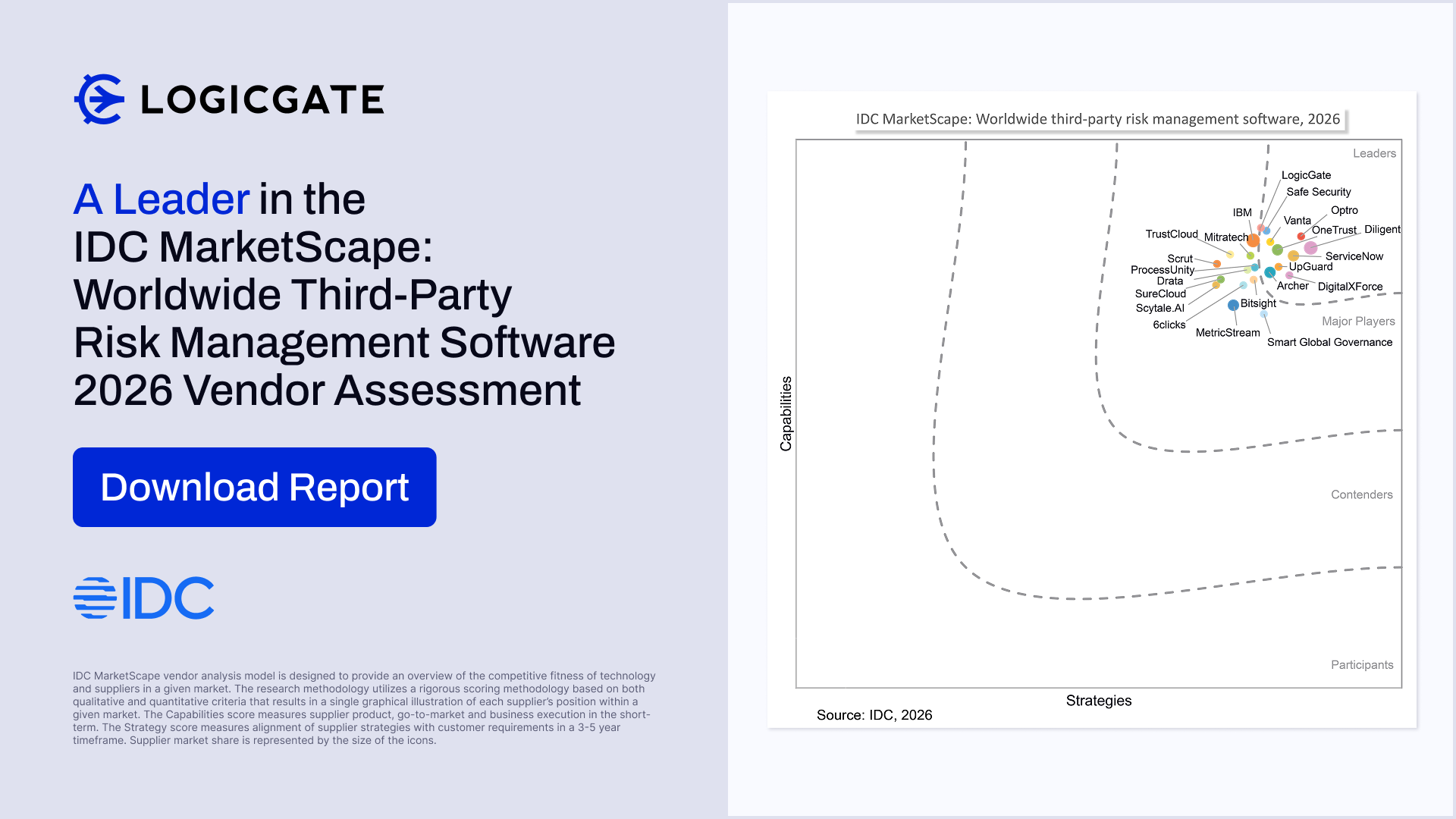
IDC frames the market the same way. Phil Harris, IDC’s research director for GRC, publishes the worldwide GRC software and services forecasts and the IDC MarketScape vendor assessments, and in his own words, “most enterprise AI still hasn’t earned the trust it’s been given,” with buyers “deploying AI faster than they are building frameworks to govern it” and vendors “shipping AI capabilities without the instrumentation that would let buyers verify those claims.”
Gartner adds a warning worth heeding. It predicts more than 40% of agentic AI projects will be canceled by the end of 2027. The cited causes are escalating costs, unclear value, and inadequate risk controls. A vibe-coded GRC program has all three problems built in.
What Does Ten-Plus Years of Implementation Experience Actually Buy You?
Best practices in GRC are not intuitive. They are earned across thousands of deployments, edge cases, and audits that no single team can replicate on its own.
LogicGate has more than a decade of experience across thousands of GRC implementations. That history is encoded in the platform as pre-built frameworks, tiered questionnaire logic, control libraries, and escalation workflows. A vibe-coded tool starts with none of it.
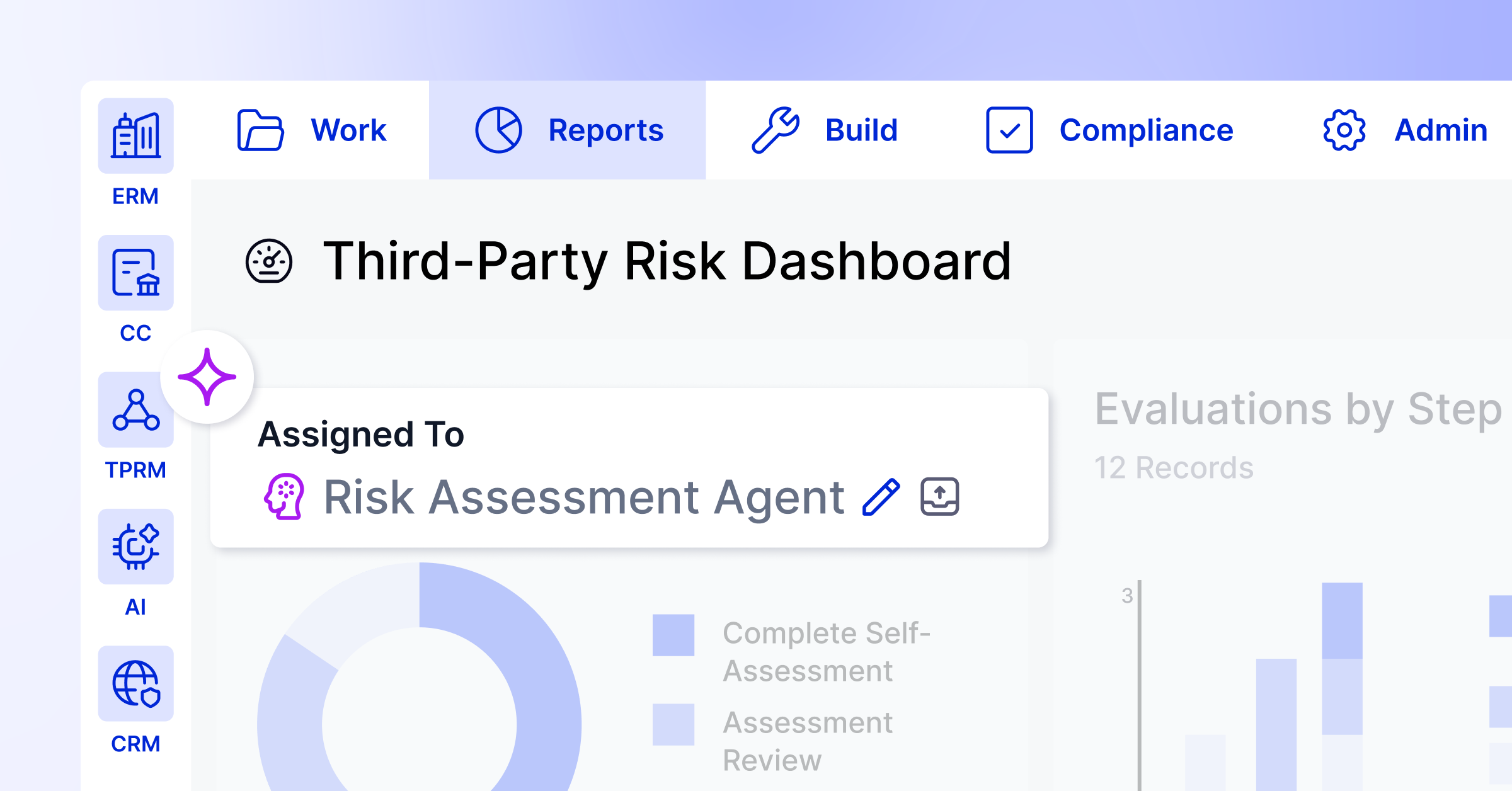
That experience also shapes our AI agents. LogicGate’s GRC Agents are purpose-built for GRC tasks, not general-purpose chat. Every action they take is logged, and every AI-generated output routes through a named human approver before it becomes an official record.
Standing up a program does not require months of engineering. Config Newton, the world’s first agentic GRC engineer, can configure workflows in days. That is a fundamentally different lift than building and maintaining tooling yourself.
The payoff is a unified view of risk your board can act on. Executive dashboards translate fragmented risk data into financial terms leaders understand. That reporting layer is precisely what a vibe-coded tool was never built to produce.
How Much Time Do Agentic GRC Solutions Save From Day One?
The foundation argument is not only about defense. A governed platform with purpose-built Agents also delivers hard time savings immediately, not after months of tuning.
Take third-party risk as an example. A TPRM Assessment Agent can save a projected ~48 minutes off every vendor assessment by drafting responses, mapping evidence, and flagging findings for review. That is time an analyst used to spend on manual busywork.
Now do the math at scale. A large enterprise running 1,500 assessments a year saves up to 1,200 hours. That is nearly a full-time employee handed back to the team.
The reclaimed capacity is the real prize. That recovered FTE can move from copy-paste questionnaire work to strategic risk analysis, board reporting, or program maturity. You are not cutting headcount; you are redirecting it to higher-value work.
Cycle time improves just as dramatically. Assessments that once took up to three weeks can compress into hours when an Agent handles the first pass. Vendors move through onboarding faster, and the business stops waiting on risk.
That speed compounds across every workflow, not just TPRM. Faster assessments mean faster deals, faster audits, and a risk team seen as an accelerator rather than a bottleneck. A vibe-coded tool cannot deliver that on day one, because there is no proven agent behind it.
When Does Building It Yourself Ever Make Sense?
Almost never, once the full cost is counted. The DIY case usually rests on three objections, and each one tends to collapse under scrutiny.
The first is cost: “a platform is expensive.” But token spend, engineering hours, and rework on a homegrown tool routinely cross a licensed platform’s cost within a year. The “cheaper” option rarely is.
The second is speed: “we don’t have bandwidth to implement.” That objection actually favors a no-code platform. Configuring proven workflows takes days, while a custom build and its endless maintenance take months.
The third is fit: “our industry is different.” Retail, hospitality, healthcare, and manufacturing do have distinct obligations. A configurable platform with industry frameworks meets them without forcing you to rebuild the fundamentals from zero. For help evaluating options, see our guide on how to choose a GRC platform in 2026.
What Should You Do Before the Next Audit?
If your GRC program is spreadsheets, scattered AI prompts, and good intentions, the gap won’t show up on a normal Tuesday. It shows up the day a regulator, customer, or board asks for the record, and by then the infrastructure can’t be built retroactively.
Book a demo today to see what a holistic program looks like from day one.
Frequently Asked Questions
It means using a general-purpose AI assistant to build risk and compliance tools without architecture, audit trails, or governance controls. The output looks functional but cannot hold up under regulatory or board scrutiny.
Yes. Consumer accounts at OpenAI, Google, and Anthropic can train on submitted content by default or through an easy-to-miss opt-in, with retention running up to five years. Enterprise and API agreements carry a contractual guarantee against training on your data that a personal account does not.
Agents act automatically on the data they read. Fragmented spreadsheets lead agents to act on stale or conflicting records, so one governed data model is what makes AI trustworthy.
Both operate under PCI DSS 4.0 and a growing patchwork of state privacy laws. Franchise and multi-location structures multiply every obligation, which fragmented tools cannot track reliably.
Healthcare handles sensitive data under HIPAA and heavy third-party breach exposure. A single vendor incident can trigger reporting duties across many covered entities, which demands an auditable, connected record.
Manufacturers manage operational-technology security, product safety, environmental rules, and complex supply chains. Defense suppliers add CMMC, and none of it fits a spreadsheet built one prompt at a time.
Studies estimate the average US firm spends between 1.3% and 3.3% of its total wage bill on compliance. That burden rises with every new privacy, AI, and cyber rule.
Forrester finds most current GRC AI augments existing work rather than transforming it, with real agentic use cases 18 to 24 months out. A governed foundation has to come first.
More than a decade across thousands of deployments produces pre-built frameworks, control libraries, and escalation logic. A vibe-coded tool has to rediscover every one of those patterns.
Rarely. Token spend, engineering hours, and rework usually cross a licensed platform’s cost within twelve months, before counting audit and breach exposure.
Every AI-generated output routes through a named human approver before it becomes an official record. Nothing reaches the risk register without that step.
A TPRM assessment Agent can save 45 to 60 minutes per assessment. At 1,500 assessments a year, that is up to 1,500 hours reclaimed, and cycle times drop from weeks to hours.